Quarterly Planning Meeting Agenda: A Reusable Template

The most popular quarterly planning advice is to give every department time to report, then discuss goals. That's how a strategy meeting becomes a status meeting with a more expensive guest list. A useful quarterly planning meeting agenda does the opposite: it limits live discussion and reserves the room for decisions that change spending, customer focus, or risk.
Start by sorting every proposed item through a decision threshold. Send routine updates in writing, identify who can make each decision, and bring only the unresolved trade-offs into the meeting. The preparation can be extensive. The live agenda shouldn't be.
A Reusable Quarterly Planning Agenda at a Glance
In 2025, 64% of recurring meetings and 60% of one-off meetings reportedly had no agenda, according to Flowtrace's State of Meetings Report. An agenda helps, but a list of departmental topics still leaves the facilitator guessing what the room must accomplish.
Use this ninety-minute quarterly planning agenda as a working template. The timings are recommended timeboxes, not a promise that an unprepared team can complete its planning this quickly.
Copy the decision sequence
Time | Agenda item | Type | Owner | Pre-read |
|---|---|---|---|---|
0:00-0:10 | Confirm constraints and the decision question | Discussion | Facilitator | Constraint summary and written question |
0:10-0:30 | Scorecard review against last quarter's targets | Information | Finance lead | KPI dashboard |
0:30-0:50 | Select quarterly priorities | Decision | Executive sponsor | Ranked priority candidates |
0:50-1:10 | Approve goal wording and resource trade-offs | Decision | Executive sponsor | Draft goal sheet and resource sheet |
1:10-1:25 | Test the top priority and resolve objections | Discussion | Operations lead | Written risks and objections |
1:25-1:30 | Read back decisions and confirm commitments | Decision | Executive sponsor | Live decision log |
The opening establishes what's fixed: available capacity, contractual commitments, cash constraints, and decisions already made. Give it a written question, such as whether the proposed plan is achievable within existing staffing.
The scorecard comes before priority selection so everyone works from the same facts. Although the review occupies a larger block, the finance lead's information delivery should take under five minutes; use the remaining time for clarification and qualifying exceptions, not presentations.
Pick priorities before dividing resources. Each candidate needs one supporting number and one named owner. Cut the list to three to five priorities before discussing staffing or budget, otherwise leaders can protect departmental allocations before agreeing on company needs.
At 0:50, read the draft goal sheet aloud. Write each goal as a sentence containing a measurable target, an owner, and a date, then identify what must stop to make it feasible.
The risk discussion tests the plan rather than reopening every rejected idea. The final readback confirms the actual commitments, including explicit refusals and unresolved questions.
Make each label mean something
Decision: Name the person authorized to decide, not just the person presenting.
Discussion: Attach a written question that the room must answer.
Information: Keep delivery brief or move it into the pre-read.
Protect time for the few consequential decisions instead of covering every function equally. Before sending invitations, check every row: no owner or no pre-read means it leaves the live agenda.
Prepare the Inputs Two Weeks Ahead
Preparation isn't a request for polished slides. It's a request for enough evidence that leaders can compare options without asking someone to retrieve a spreadsheet during the meeting. Use a shared Google Doc for the narrative and a linked spreadsheet for the scorecard and resource sheet.
Use a staged preparation sequence
Two weeks out, request the scorecard updates. Send the same template to every KPI owner and cap each written update at 200 words. Ask for target, actual, variance, likely cause, and the decision required. An update delivered on meeting morning turns the performance review into a live research session because nobody has checked its assumptions.
One week out, circulate the complete pre-read. Include last quarter's scorecard, the priority candidate list, and the resource sheet. Show committed work alongside proposed work, including the people needed by competing projects. A candidate without a supporting number belongs on the question list, not the decision list.
Three days out, open written questions and dissent. Ask participants to comment directly beside the proposal they're challenging. Require the proposal owner to answer factual questions before the meeting. Otherwise, leaders spend scarce decision time resolving definitions that could have been settled in writing.
The resource sheet deserves particular attention. A budget can appear available while the only employee capable of delivering the work is already committed elsewhere. Name constrained roles and dependencies rather than treating headcount as interchangeable capacity.
Give distributed contributors a fair deadline
Set a shared deadline that accommodates the most distant time zone, and display its local equivalent for everyone. Don't make headquarters' end of day the default cutoff if that removes another participant's working day.
Late input becomes a written comment, not an automatic agenda change. The executive sponsor can make an exception for a material customer, safety, or financial risk, but the contributor must explain why the decision can't wait.
Readiness test: If an item can't be explained in two sentences with one supporting number, send it to next quarter's review rather than asking the room to finish preparing it.
That rule applies to discretionary planning candidates. Urgent operating problems still need an owner and a separate resolution path; they shouldn't disappear because their documentation is incomplete.
Which Items Need a Live Debate
Employees rate meetings as ineffective 72% of the time, while hybrid workers cite meetings running too long (45%), excessive meeting volume (41%), and meetings that should have been email (39%), according to Coommit's meeting and hybrid-work summary. The practical response is triage, not a more elaborate presentation template.
Use the following thresholds as proposed operating rules, not universal financial controls. Set them before collecting agenda items so a persuasive department head can't negotiate a special exception halfway through the meeting.
Decision threshold for each agenda item
Item | Discuss live | Handle async | Decide at executive level |
|---|---|---|---|
KPI miss of 10% or more against target | Yes | Written root cause | Yes |
KPI variance from 5% to 9% | No | Written root cause | No |
KPI variance under 5% | No | Written update | No |
Resource shift between departments | Yes | Pre-read comments | Yes |
Vendor renewal under approval limit | No | Async approval | No |
Strategic priority change | Yes | Pre-read input | Yes |
A significant KPI miss earns live debate because leaders may need to change the plan. A smaller variance normally needs an explanation and departmental action, not executive airtime. For fractional variances between the displayed bands, use the lower band unless a risk override applies.
Budget size, team count, and consequence should determine your final thresholds. A small percentage movement in a cash-critical measure can matter more than a larger movement in a secondary activity metric. Document those exceptions in advance.
Resource transfers require executive authority because the receiving department's gain can undermine another team's commitments. Likewise, changing a strategic priority affects more than the person proposing it. Invite input broadly, but don't confuse participation with decision rights.
A vendor renewal below the company's existing approval limit belongs with the department lead unless its scope or risk has materially changed. The quarterly session shouldn't become a purchasing queue.
For decisions that need deeper option analysis, use a separate strategy offsite agenda rather than stretching the quarterly session indefinitely.
A discussion item without a written question is an information item wearing the wrong label.
The facilitator should move it to the pre-read. Nobody should have to discover its purpose while the clock is running.
How to Run the Performance Review Block
The performance review supplies evidence for the plan. It isn't a courtroom, and it isn't the place to solve every operating problem. Keep a single KPI summary visible and appoint a recorder so the facilitator can manage the conversation rather than type continuously.
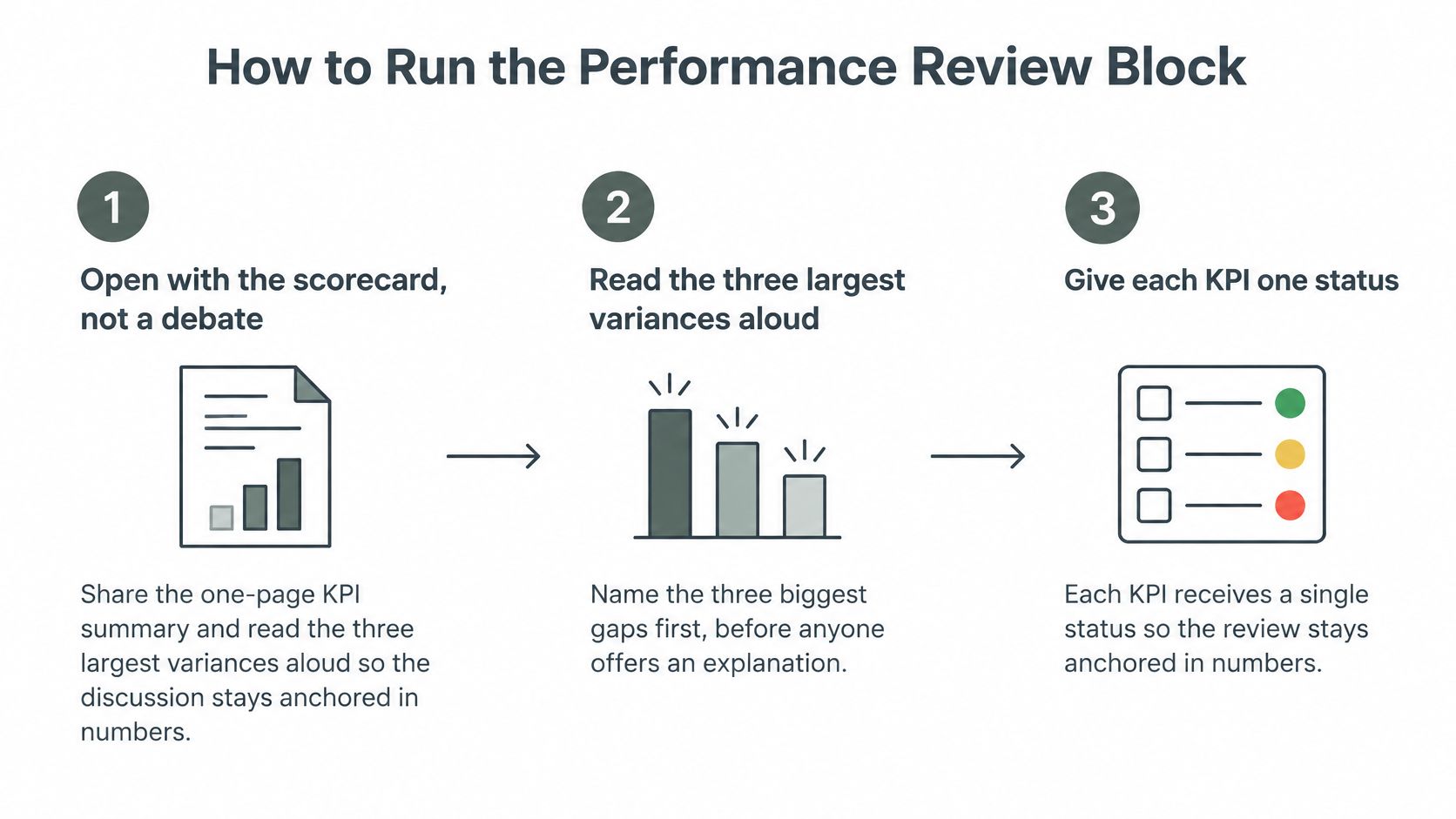
Use the process visual as a reminder to establish the facts before inviting explanations.
Establish the facts first
Open with the scorecard, not a debate. Share the one-page KPI summary and read the three largest variances aloud before anyone explains them. This gives participants a common starting point. The common slip is opening with a department's narrative and allowing its preferred explanation to frame the numbers.
Give each KPI a status: on track, at risk, or missed, followed by its owner's name. Agree on status definitions during preparation, not in the room. Otherwise, participants can spend the block debating whether an unfavorable result deserves a softer label.
Ask a narrow diagnostic question. For each missed target, ask what changed in the market, the team, or the spend. Don't request a complete history. Say a bakery's wholesale orders fell while retail sales held steady: the useful question concerns wholesale demand or account coverage, not everything the bakery did that quarter.
Capture enough to act
Write the root cause in a single sentence in the decision log before moving on. Distinguish an established cause from a working hypothesis. If the team suspects slower response times but hasn't checked the records, assign validation rather than recording the explanation as fact.
Park investigations that need more than five minutes. Name the follow-up owner, the question to resolve, and the date the answer is due. Parking an issue without those details is avoidance; assigning a bounded investigation protects the planning session without abandoning the problem.
Close with a one-line summary per KPI and move directly to priorities. State the result, its implication, and any assigned follow-up. Don't invite another round of explanations after the summary, or participants will learn that the timebox is negotiable.
Apply the debate threshold during preparation: only misses of 10% or more receive live debate under this proposed model. Smaller misses close with a concise summary and written handling, including a root-cause note where required.
The hard case is a large miss with an incomplete explanation. Don't force certainty to achieve a tidy meeting. Record what's known, name what remains unknown, and decide whether to pause the affected commitment or authorize a limited next step.
A successful review doesn't explain everything. It gives leaders enough reliable information to choose what happens next.
Keep Hybrid and Dissenting Voices in the Room
Meeting starts consume about six minutes on average, 18% of respondents say starts regularly take more than ten minutes, and 38% report meeting fatigue, according to Acta's quarterly-planning guidance. Protecting participation requires more than adding a video-call invitation.
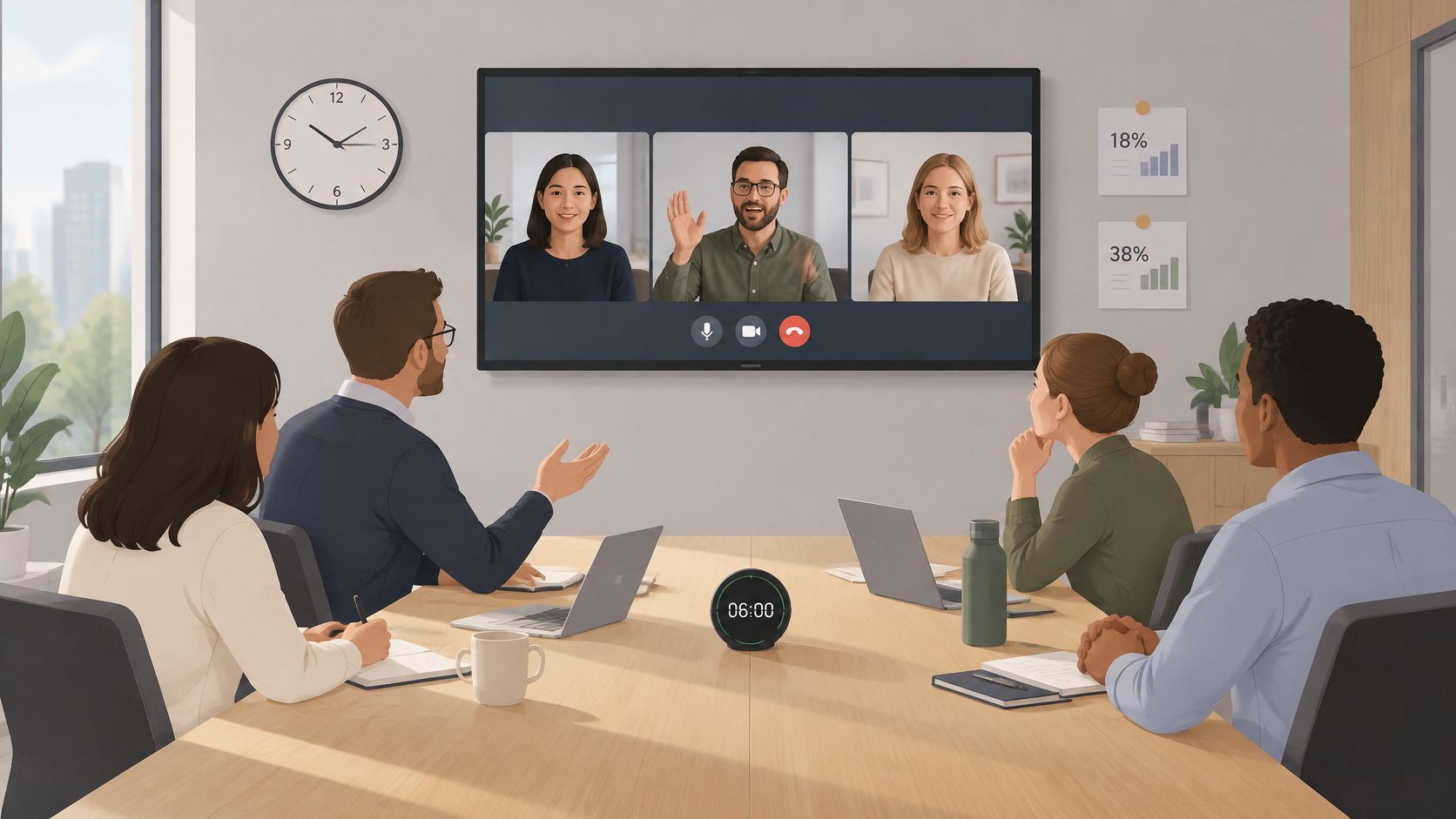
Arrange the room so remote participants can hear every contribution, not just the person nearest the laptop.
Separate access from agreement
Rotate speaking order each quarter. Don't let the founder and finance lead establish the answer before anyone else contributes. Ask a remote participant or the person responsible for implementation to speak early, and have the executive sponsor give their preference after others have contributed.
Run a five-minute pre-mortem on the leading priority. Assume the quarter failed, ask each person to write three reasons, then read them aloud before confirming the plan. Silent writing prevents the fastest speaker from determining which risks everyone considers.
Check the technology before substantive decisions. Test microphones from the remote participant's end, use a shared screen, and ask for cameras during decisions where accessibility and connection quality allow. Keep the written proposal visible so facial expressions don't become the only signal of agreement.
Use this video alongside the team's facilitation preparation.
Give the offsite distinct purposes
Strategic decisions can happen live with distributed contributors. Relationship-building and creative ideation may benefit from an intentional in-person setting, but they shouldn't consume the decision block.
Separate formal planning from the social portion of an offsite. Don't reopen a settled priority over lunch when remote colleagues are absent. For practical setup and participation controls, use our guide to running a hybrid meeting.
Before confirming each priority, require at least one written objection on record. This isn't a veto or an invitation to manufacture hostility. Ask someone to state the strongest credible downside, then record whether the team accepts the risk, changes the proposal, or needs more evidence.
Silence isn't sufficient evidence of agreement, especially when the person who must deliver the work hasn't spoken.
Send the Decision Log Within 24 Hours
Send the decision log within 24 hours. A log delivered a week later forces owners to reconstruct commitments from memory and repeat the planning conversation in their next one-to-one.
Give every decision these fields:
Decision: The commitment in a sentence.
Owner: The person accountable for delivery.
Deadline: The agreed completion date.
Stop doing: The work being removed to create capacity.
Add next quarter's review date and the parked questions, each with an owner. Check the log against the agenda: every row should map to a decision, an open question, or an explicit no. For the scorecard row, that can mean confirming that no corrective action is required.
Keep circulation disciplined. Our business meeting etiquette guide supports clear follow-through without turning the log into another round of debate.
A quarterly planning meeting succeeds when it produces fewer decisions with clearer owners, not more agenda items.
If the session needs a private room for a half day, our members-only Freeform House venue offers reservable conference rooms and private workspaces in Jenks's 10 District, the downtown area defined by The Ten District.
Envisioned as a premier membership-based club in the heart of Jenks, Oklahoma's 10 District downtown, Freeform House shares the broader club-and-workspace concept associated with SoHo House, offering more than a social gathering place. Our co-working spaces, open collaboration areas, hot desks, and reservable conference rooms support focused planning and a community hub for local collaboration, connection, and creative cooperation. Visit Freeform House to book a personalized consultation about pricing structures, opening dates, and becoming a member, and discuss the setting your next quarterly planning session needs.
Comments