Professional Office Environment Guide for Modern Teams

You know the feeling. Monday morning starts at your kitchen table, Tuesday turns into a string of calls from a coffee shop, and by Thursday you're driving into town because one client meeting, one strategy session, and one hard problem all feel easier face to face. Then you get there and realize the space still isn't helping. The Wi-Fi stutters, the room echoes, someone takes a call three feet away, and the “office” is really just furniture with a mailing address.
That's where a lot of local entrepreneurs get stuck. They assume a professional office environment is mostly about appearance. Nice chairs, clean finishes, a conference table, maybe a good coffee setup. Those things matter, but they don't explain why one space helps you think clearly while another makes even simple work feel heavy.
A professional office works more like a system than a showroom. It supports focus when you need quiet. It makes collaboration easy when your team is together. It helps clients trust what they're seeing before you even begin the meeting. In a hybrid world, that matters more than ever because the office has to earn the trip.
That shift isn't theoretical. Gallup reports that 52% of U.S. employees in remote-capable jobs were hybrid as of May 2026, while 26% were fully remote and 22% were on-site, and hybrid workers spent the equivalent of 2.3 days per week in the office, or 46% of the workweek according to Gallup's hybrid work indicator. The point is simple. People still use offices, but they use them selectively.
If you're choosing a membership club, setting up a small headquarters, or rethinking how your team gathers downtown, the right question isn't “How polished does this look?” It's “What kind of work does this space make easier?”
Introduction to What Makes Work Feel Professional
A space starts to feel professional when it removes friction.
That might mean your laptop connects instantly, the lighting doesn't give you a headache by noon, and there's a room where you can discuss pricing or personnel without lowering your voice. It might also mean a client walks in and feels the difference between a borrowed corner and a place designed for serious work.
Why the office has a different job now
For years, people treated office space like a container for desks. Fill the floor, assign seats, keep everyone present. That model doesn't fit how many teams work anymore. Office attendance is more intentional, and that changes what “professional” needs to mean.
CBRE found that global office utilization reached 53% in 2026, up from 38% in 2024 and 35% in 2023 in its global workplace and occupancy insights. So offices are seeing more activity again, but nearly half of capacity still sits unused at a given time. That's why smart operators aren't designing only for density. They're designing for purpose.
A polished office impresses people for a minute. A functional one supports them all day.
What readers usually miss
A professional environment is first assessed by what's visible. Furniture, paint, branding, finishes.
What they miss are the hidden variables that shape performance:
Sound: Can you concentrate, or are you hearing every chair scrape and side conversation?
Air: Does the room feel fresh, or does it get stale after one long meeting?
Light: Can you work comfortably without glare, dim corners, or washed-out video calls?
Choice: Is there somewhere to go for a call, a brainstorm, a quiet hour, and a client presentation?
Those are the practical signals of a professional office environment. They're the difference between a place that photographs well and one that carries a workday.
Understanding the Core Concept Behind a Professional Office
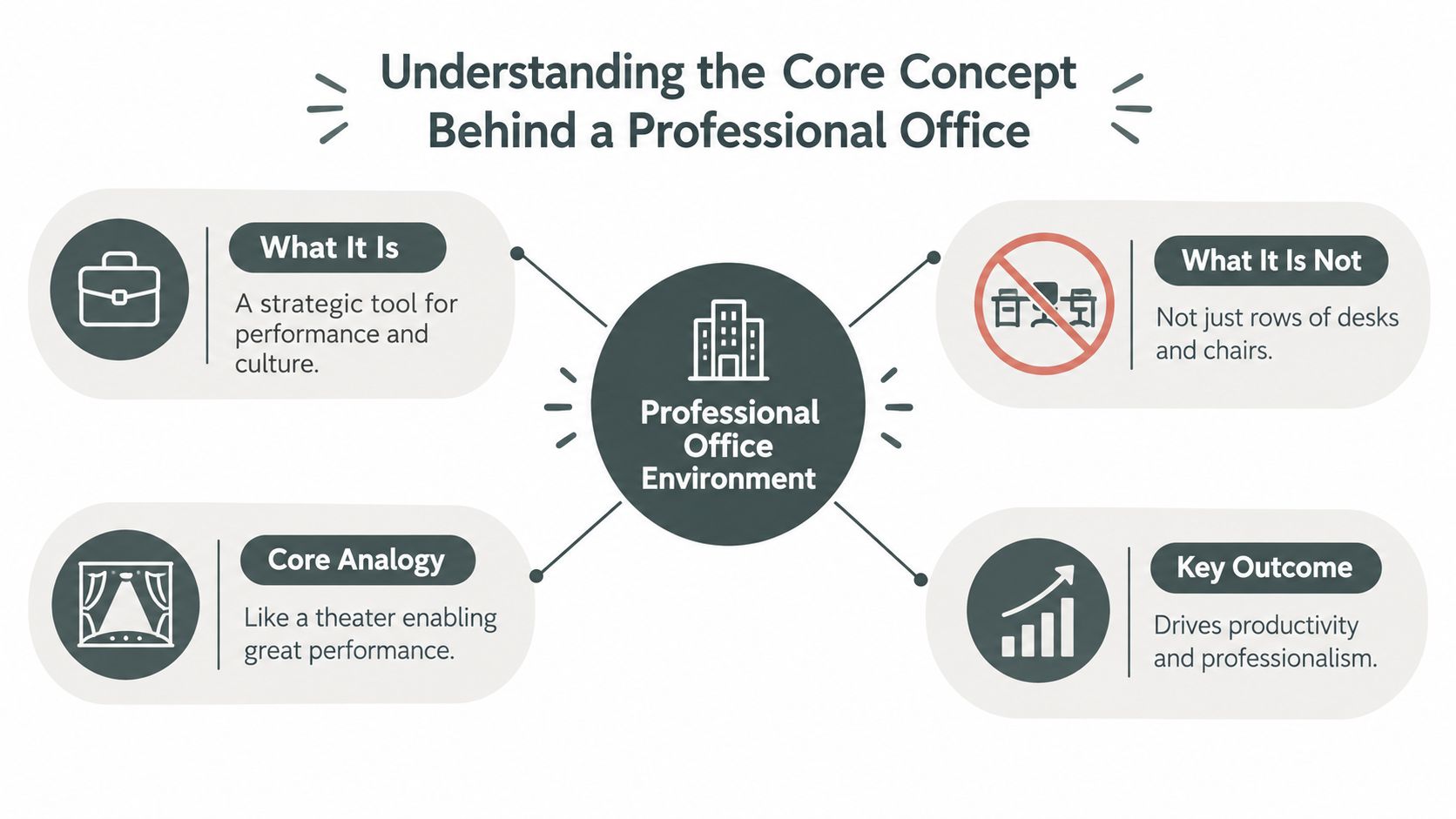
A professional office environment isn't a pile of good ingredients. It's a coordinated experience.
Think of a piano in a lobby. The wood may be beautiful, the bench may be perfect, and the room may look impressive. But if the instrument is out of tune, no one cares how elegant it looks. Offices work the same way. A room with stylish finishes, expensive desks, and modern art still fails if it makes concentration hard, meetings awkward, or clients uneasy.
What it is and what it isn't
A professional office environment is a system that supports performance, trust, and coordination.
It is not just:
Rows of desks: Useful for headcount, but not enough for varied work.
A design style: Minimalist, industrial, traditional, and modern can all work.
A luxury signal: Expensive doesn't automatically mean effective.
What matters is whether the space helps people move smoothly between different work modes. That includes focused solo work, quick problem-solving, formal meetings, private conversations, and the informal interactions that keep a small business moving.
The office as a stage for different kinds of work
A better analogy is a theater. The audience sees the stage, but the performance depends on lighting, acoustics, timing, cues, backstage flow, and the ability of everyone to do their part without friction.
That's what a professional office does. It gives each activity the right setting.
Gensler's 2025 Global Workplace Survey, summarized in this workplace design trends article, found employees spend about 55% of the week in the office but believe they need to be there closer to 65% to perform at their best. The same summary notes only 26% strongly agree their workplace helps them do their best work, while employees with high choice in where and how they work are 2.5x more likely to say the workplace supports both individual and team productivity.
That tells us something important. The problem usually isn't “We need more desks.” It's “We need better fit.”
Practical rule: Judge a workspace by the tasks it supports, not by the furniture it contains.
A simple test you can use
When you tour a space, ask four plain questions:
Can I focus here without fighting the room?
Can my team gather here without improvising?
Can I host a client here without apologizing for something?
Can different people work in different ways without getting in each other's way?
If the answer is yes across all four, you're closer to a true professional office environment than many bigger, flashier spaces.
How Design Acoustics and Lighting Shape Performance
Some office problems are obvious. Others are invisible until your energy drops, your calls feel harder, or your team starts avoiding the space.
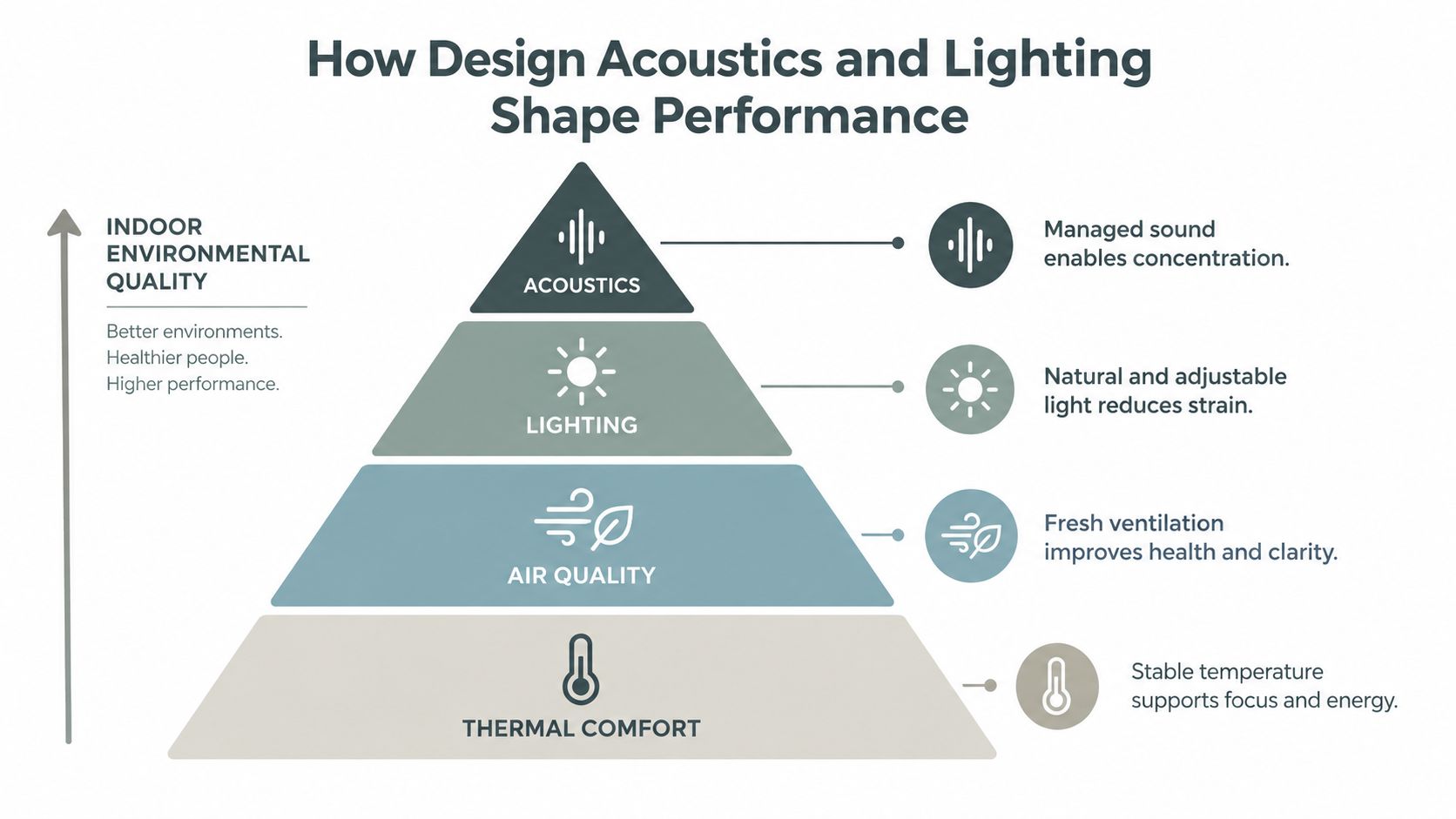
Researchers typically assess indoor environmental quality through four connected domains: thermal comfort, indoor air quality, lighting, and acoustics, as outlined in this review on office indoor environmental quality. The key word is connected. People don't experience these factors one at a time. They experience the room as a whole.
The four conditions people feel before they can name them
A room can look calm and still perform badly. Here's what to watch for.
Thermal comfort: If one side of the room runs cold and the other gets stuffy, people spend mental energy adjusting instead of working.
Air quality: Stale rooms make long meetings feel longer. Fresh ventilation supports clearer thinking.
Lighting: Good light helps with reading, screen work, eye comfort, and camera presence.
Acoustics: Sound control determines whether people can stay on task or keep resetting their attention.
A useful design reference can also come from seeing how clean visual planning supports concentration. If you want a style example, this modern minimalist office article shows how less visual clutter can support calmer work settings.
What the benchmarks actually mean in practice
The performance side of this isn't guesswork. A major evidence review from the World Green Building Council reports that improved ventilation has been associated with up to 11% productivity gains, while poor air quality and high temperatures can reduce performance by up to 10%. The same review recommends background noise around 45 dBA in open-plan offices and about 40 dBA in private offices, with typical task lighting in the 300 to 500 lux range, according to the WorldGBC health, wellbeing and productivity report.
That sounds technical, but the everyday meaning is simple:
Around 45 dBA means open areas should feel controlled, not hushed like a library and not noisy like a café.
300 to 500 lux means enough task light to read, write, and review details without over-lighting the whole room.
Better ventilation often shows up as fewer afternoon slumps and less “meeting fog.”
Spaces don't fail only because they're ugly. They fail because the body notices strain before the mind can explain it.
A quick visual can help make those design choices more concrete.
A fast walk-through test
When you visit a potential office, don't just stand in the lobby. Work in it for a while.
Try this:
Sit in two different zones: One near activity, one away from it.
Read on paper and on screen: Bad lighting often shows up faster on white paper and video calls.
Stay through a meeting cycle: Noise and air problems become clearer when the room fills up.
Notice recovery time: In a good room, attention returns quickly after interruption.
That's how you catch the issues that pretty photos hide.
Technology Meeting Spaces and Privacy That Work Together
Hybrid work breaks down fast when the toolkit doesn't match the promise.
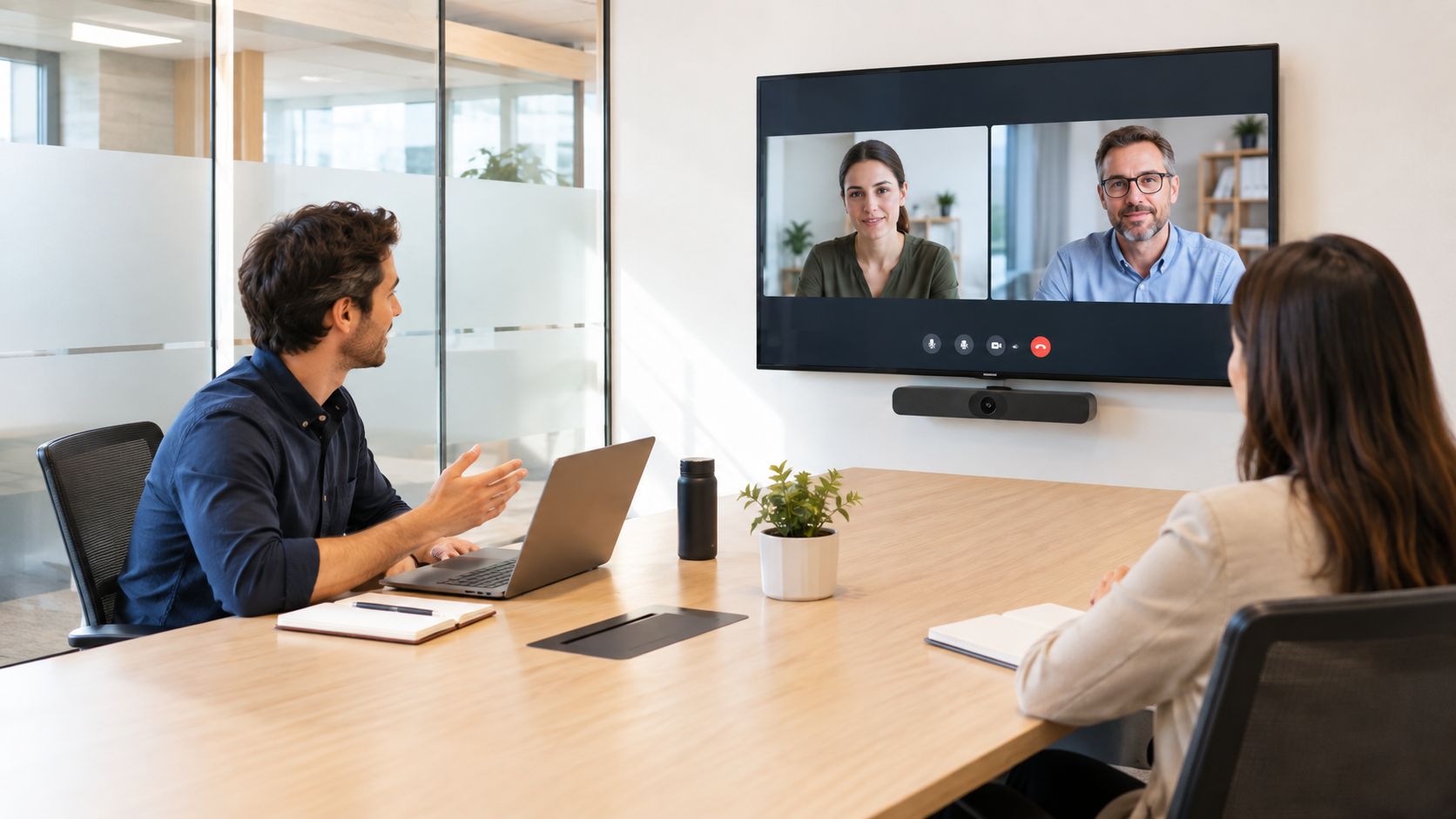
A room may look executive, but if the camera angle is awkward, the connection drops, or the glass walls carry every word into the hallway, the experience stops feeling professional. That's why technology, meeting space, and privacy need to work as one system.
What to test before you commit
Small business owners often ask whether a space has “good tech.” That question is too broad. Test the parts that affect real work.
Connection reliability Don't just ask whether Wi-Fi exists. Join a call, upload a file, and move between rooms. If performance drops sharply when you change locations, the space may work for casual browsing but not for client-facing work.
Meeting room usability A room should be easy to reserve, simple to enter, and ready to start without hunting for adapters or reconfiguring furniture. The fewer steps between “let's meet” and “we're working,” the better.
Call-ready privacy Open space is useful for energy and conversation, but people still need enclosed places for recruiting calls, financial discussions, therapy-adjacent coaching work, and vendor negotiations.
If you're thinking about what a strong setup looks like in practice, this video conferencing setup guide is a helpful reference for the details that affect call quality and meeting flow.
Open collaboration and quiet focus need each other
Many offices get lopsided. They either become too open or too enclosed.
A strong layout usually includes:
Shared zones: Good for quick discussions, drop-in collaboration, and social energy.
Phone booths or enclosed nooks: Essential for one-person calls and concentrated tasks.
Formal meeting rooms: Better for strategy, sales presentations, and hybrid team sessions.
Soft-transition areas: Lounges, counters, or small tables where people can regroup without occupying a major room.
Coworking research supports that balance. A 2024 scoping review on coworking productivity found productivity in coworking spaces is positively associated with social support and interaction, while inadequate ICT infrastructure and late opening times are associated with reduced productivity.
Field check: If you have to leave the building to take a private call, the workspace isn't fully supporting professional work.
How to spot a room that only looks the part
Watch for these warning signs:
Echo on hard surfaces: A stylish boardroom with too much reverberation drains energy on long calls.
One-size-fits-all seating: Great for photos, less great for a two-hour planning session.
No obvious camera position: If everyone has to cluster around a laptop, the room wasn't built for hybrid use.
Visible but not protected privacy: Frosted branding and glass partitions can still leak sound.
A professional office environment doesn't need every gadget. It does need tools that disappear into the background so people can focus on the work itself.
Hospitality Culture and Policies That Support Great Work
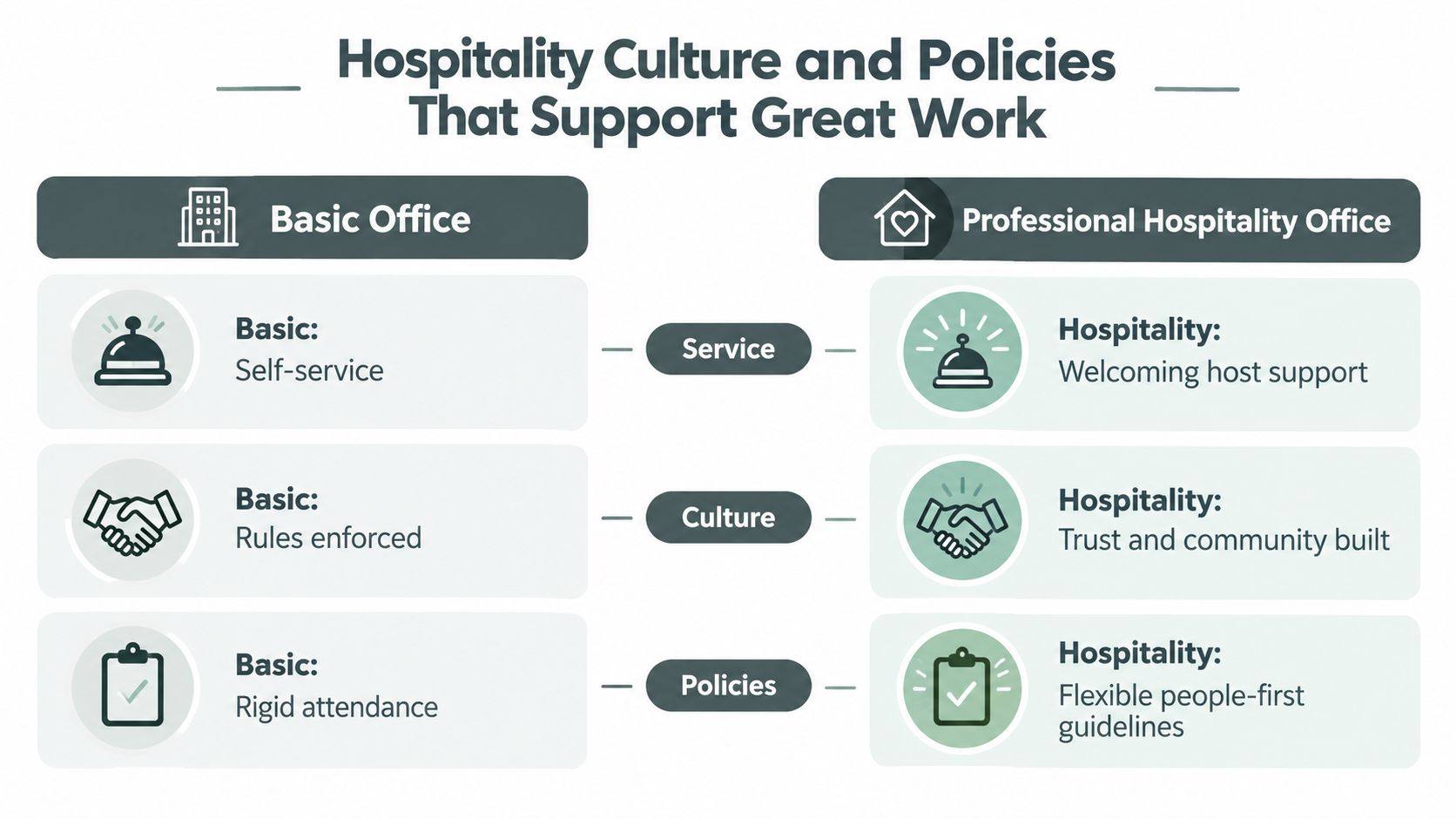
The physical setup gets people in the room. Hospitality and policy determine whether they want to come back.
That's especially true for entrepreneurs, small teams, and independent professionals. When you don't have a giant corporate infrastructure behind you, the daily experience matters more. A warm greeting, a predictable booking process, clear norms for shared spaces, and services that remove friction can make a workday feel organized instead of scattered.
What hospitality means in a work setting
Hospitality in an office doesn't mean turning the place into a hotel lounge. It means designing service around people's working rhythm.
That can include:
Simple arrival: Clear access, easy check-in, and no awkward first five minutes.
Predictable support: Someone can help when a room, screen, or booking issue appears.
Thoughtful house rules: Policies reduce uncertainty without making the place feel policed.
Comfort with boundaries: Members know where they can collaborate, take calls, host, or work.
A good hospitality layer makes professionalism easier to perform. You're not improvising logistics all day.
Hospitality and Culture Features Compared by Work Impact
Feature | Primary Benefit | What to Look For |
|---|---|---|
Reception or host support | Reduces friction and improves first impressions | A visible welcome point, help with guests, and smooth room access |
Clear shared-space norms | Protects focus and lowers conflict | Quiet zones, call rules, and respectful use of common areas |
Food and beverage support | Keeps momentum during long sessions | Easy ordering, nearby service, or on-site options that don't interrupt meetings |
Flexible booking policies | Supports real working patterns | Short-notice room access, practical cancellation terms, and simple scheduling |
Member community practices | Builds trust and useful connection | Introductions, recurring gatherings, and behavior that feels cooperative rather than forced |
The difference between amenity and support
A bowl of snacks is an amenity. Reliable room turnover before a client meeting is support.
A stylish lounge is an amenity. A culture where people know not to take loud calls in a focus zone is support.
A recent PubMed study on coworking compared with working from home links coworking with better outcomes than working from home on well-being, work engagement, and productivity, while noting that the effect of other people in the room depends on whether the task is collaborative or individual. That lines up with what operators see on the ground. People don't just need company. They need the right kind of company, in the right place, at the right time.
Good culture is visible. You can hear it in the noise level, see it in how rooms are shared, and feel it in how easily work gets done.
Inside Freeform House and What It Teaches About Professional Space
One useful way to understand workspace design is to study a real place instead of another abstract checklist.
Free Form House is envisioned as a premier, membership-based club in the heart of Jenks, Oklahoma's 10 District downtown. Comparable to the renowned SoHo House, it offers more than just a social club. Members can take advantage of co-working spaces and a dynamic community hub designed for collaboration and connection. It's a central gathering spot aimed at fostering a creative and cooperative spirit within our local community.
The broader lesson isn't about copying one aesthetic. It's about seeing how a restored Main Street property can function as a modern professional environment when its spaces are arranged around actual work patterns.
What a mixed-use club model teaches
The publisher describes Freeform House as operating from a restored 1920 building with 10,000 square feet across three stories, with four distinct rooms, a loft studio called The Rise, and an in-house podcast booth. That combination matters because it shows how professional space can support more than one mode of work without flattening everything into one open room.
A founder might use one room for heads-down planning in the morning, host a private meeting at midday, record audio content later, and end the day with a small gathering. The building isn't acting like a single-purpose office. It's acting like a choice-driven work platform.
For local readers, the nearby context also matters. A downtown club connected to restaurants, coffee, and walkable activity supports a workday differently than a sealed suburban office park. That setting can turn a meeting into lunch, a solo work block into a collaborative afternoon, or a chance encounter into a new project.
What to notice when you visit a place like this
Use any restored club or coworking site as a learning lab.
Look for:
Room identity: Does each room clearly support a different kind of work or hosting?
Support services: Do conveniences like lockers, food partnerships, or local transport reduce daily friction?
Creative capability: Are there spaces for content, workshops, or presentations, not just laptop work?
Historic character plus modern function: Does the charm help the experience without making the building less usable?
For readers who want to see how these ideas connect to broader local redevelopment, this look at the next innovation center adds useful context.
One visual note matters too. Make sure none of the pictures look like clip art. I just want it to look realistic and authentic. That standard applies beyond marketing. If a workspace presents itself with staged, generic imagery, it often suggests the experience hasn't been thought through in enough detail. Real spaces should look lived in, usable, and grounded in their community.
Your Checklist for Creating and Choosing the Right Environment
The best professional office environment isn't the fanciest one. It's the one that supports the way your work happens.
If you're evaluating a coworking membership, building out a small office, or choosing a club space for your team, use this checklist during a trial day instead of relying on a short tour.
A practical walk-through checklist
Focus support: Can you find at least one place where you can work for an hour without interruption?
Meeting readiness: Is there a room you'd feel comfortable using for a client conversation today, without rearranging half the setup?
Call privacy: Can you take a confidential call without stepping outside or whispering?
Lighting comfort: Do your eyes feel fine after screen work, reading, and one video call?
Air and temperature: Does the room still feel comfortable after people have been in it for a while?
Technology ease: Can you connect, present, and join a call without asking for help every few minutes?
Hospitality layer: Are arrival, booking, food, and guest hosting handled smoothly enough to protect your momentum?
Behavioral fit: Do people in the space act in ways that support work, or do they constantly interrupt it?
Choice of settings: Can you move between solo work, collaboration, and informal conversation without changing buildings?
Client impression: Would this space strengthen trust in your business the moment someone walks in?
How to test a space honestly
Don't evaluate during the quietest hour.
Try the space when it's active. Take a real call. Join a real meeting. Sit in the chair you'd use, not just the one near the window. Walk the path a guest would take. Notice whether the environment makes you feel more organized or more fragmented.
For some professionals, one option might be a private suite. For others, it may be a membership club, a focused coworking floor, or a hybrid setup that combines home work with bookable rooms. One example is Freeform House, which offers members coworking access, private workspaces, and reservable conference rooms within a club setting. The point isn't to choose what sounds impressive. It's to choose what your work can rely on.
Choose the space that earns the commute, protects your attention, and helps you show up well for other people.
A good office doesn't force one way of working. It gives you the right options at the right time.
If you're looking for a real-world example of these ideas in action, Freeform House offers a members-only workspace and club environment in downtown Jenks built for focused work, meetings, hosting, and community connection. Visit to see how a restored Main Street setting can support the kind of professional office environment that hybrid teams and local entrepreneurs need.
Comments