How to Plan a Corporate Holiday Party in 8 Weeks

In 2024, 64% of companies planned to hold a holiday celebration, according to Challenger, Gray and Christmas's survey of 173 human-resources and business leaders. That leaves more than a third choosing not to, which tells you the party can't coast on tradition. If you're spending the money, you need a reason people will show up, stay comfortable, and leave safely.
Learning how to plan a corporate holiday party in eight weeks means treating participation styles, alcohol safety, and guest privacy as budget lines from day one, not problems you patch in December. Plan for the employee who doesn't drink, can't stay late, or would rather talk in a quiet corner than shout over a DJ. You'll get better attendance and fewer awkward apologies afterward.
Objectives, Headcount and Invitations to Lock First
Don't pick the venue first. That's the most common expensive mistake, because a beautiful room sized for the wrong headcount and the wrong purpose forces every later decision into a compromise. Lock the purpose, then the people, then the place.
The habit is understandable. Parties feel automatic, but they're not universal. In a 2015 Society for Human Resource Management survey of 385 HR professionals, 65% said their organizations planned to hold an end-of-year or holiday party open to all employees, while 30% said their organizations did not usually hold one, compared with 17% in 2012, according to HR Dive's report on the SHRM survey. Among organizations holding a party, 83% reported having a dedicated budget and 67% expected to hold the event off-site. In plain terms, you need to justify this event like any other spend.
Write One Purpose You Can Test
Pick one primary goal and write it as a single sentence. Recognition, retention, cross-team connection, and client relationships all lead to different rooms, timings, and guest lists. You can't optimize for all four at once.
A recognition party needs a short, audible program and time for managers to thank people by name. A cross-team party needs seating and activities that mix departments without forcing strangers into games. A client event needs a quieter welcome, tighter hosting, and a clear end time. Write the sentence down, for example, "This party exists so remote and on-site staff meet at least two people outside their team." Every later request gets tested against it.
If a proposed expense doesn't serve the written purpose, cut it before you cut food, transport, or accessibility.
Poll Before You Promise Anything
Send a short employee poll before you announce a format. Keep it to five questions so people finish it, and check your preferred date against year-end deadlines and competing client events first.
Preferred date: Offer two or three real options, not an open text box.
Format: Seated dinner, stations, daytime lunch, or early evening reception.
Dietary needs: Allergies and restrictions, collected confidentially.
Accessibility needs: Step-free access, seating, hearing support, quiet space.
Getting home: Driving, rideshare, shuttle, or staying nearby.
Use the answers to build a rolling headcount. Start with an early estimate for venue capacity and staffing, then set a final RSVP deadline about four weeks out. Reconfirm one week before the event. Treat requests after the deadline as a draw on your contingency, not a reason to rebuild the seating plan at midnight.
Invite Everyone the Same Way
Send invitations through one channel, at one time, with identical details. When one team hears about the party from a manager and another finds out in the hallway, you've created a fairness problem before anyone arrives.
State the date, start and end time, dress code, venue address, and what the evening includes. Be explicit about plus-ones, because guest allowances change capacity fast. Say whether employees can leave after dinner without attending a later activity. Say that attendance isn't mandatory, and mean it.
You should finish this stage with three things you can defend to finance: a written purpose statement, poll results that reflect most of the team, and a headcount range with a deadline attached. Without those, any venue quote is guesswork dressed up as a plan.
Budget and Timeline Templates to Start From
Start with math, not a venue shortlist. Divide your total approved spend by the headcount you can realistically expect. That per-attendee cap tells you immediately whether you're planning a seated dinner or talking yourself into one you can't staff properly.
Attendance uncertainty is exactly why the model matters. 40% of surveyed corporate clients reported concern that employees would not attend, while roughly 60% were planning in-person holiday events, according to WorkLife's corporate holiday party attendance reporting. A per-attendee budget flexes when RSVPs move. A single lump sum doesn't.
Say a team of 120 has a $90,000 cap, purely as a worked example. That's $750 per guest. Food and beverage should land between $225 and $300 per guest, and the venue roughly $150 to $225. If a venue quote eats half the cap before catering, you already know the plan's out of balance.
The Budget Table to Copy
Use planning shares, not vendor promises, to judge each quote. Copy this structure into one sheet and keep three columns beside it for every line: quoted, confirmed, and actual.
Budget line | Planning share | What it covers |
|---|---|---|
Venue and room hire | 20% to 30% | Room fee, setup, minimum spend and any overtime |
Food and beverage | 30% to 40% | Meals, bar, nonalcoholic drinks and service charges |
Entertainment and programming | 8% to 12% | Speakers, music, activities and recognition gifts |
Décor and AV | 5% to 8% | Lighting, signage, microphone and captioning |
Transportation and safe rides | 3% to 5% | Rideshare credits, shuttle or hotel block |
Staffing and service | 5% to 8% | Event staff, host, cleanup and gratuity if not included |
Accessibility and extras | 2% to 4% | Accessible seating, quiet room and printing |
Contingency reserve | 10% to 15% | Late headcount changes and supplier substitutions |
Set aside the 10% to 15% contingency before you book anyone. It's not a décor fund for week seven. It pays for late headcount changes, a substituted dish, extra rideshare credits, and the overtime bill when speeches run long.
Build Separate Lines or Lose Control
Give food, beverages, service charges, entertainment, décor, transportation, accessibility, contingency, and taxes their own rows. Bundled quotes hide the trade-offs. A caterer who looks cheaper may have pushed service charges into a footnote, while a venue with a low room fee may require a minimum spend that belongs in your food and beverage line.
Show each line as a share of the total as quotes arrive. When one vendor creeps above its planning share, you have three honest options: negotiate, reduce scope on that line, or take money from a lower-priority line on purpose. Don't secretly raid transportation or accessibility to fund entertainment. Those cuts show up on the night as safety and inclusion failures.
Practical rule: Protect food quality, safe rides, and accessible space first. Guests forgive plain décor. They don't forgive hunger, exclusion, or a stranded ride home.
Finish this stage by writing down four numbers: target headcount, per-attendee cap, contingency amount, and budget approval date. Put them at the top of the sheet. Every vendor conversation gets easier once those numbers stop moving.
Your timeline should mirror the budget. Get approval eight weeks out, sign the venue by week seven, and don't let invitation design consume the week meant for vendor contracts. Money decisions first, creative decisions second.
Eight-Week Countdown From Venue to Event Day
Work backward from the party date and give every task an owner and a finish line. A task without a "done when" test will drift until it becomes someone's emergency.
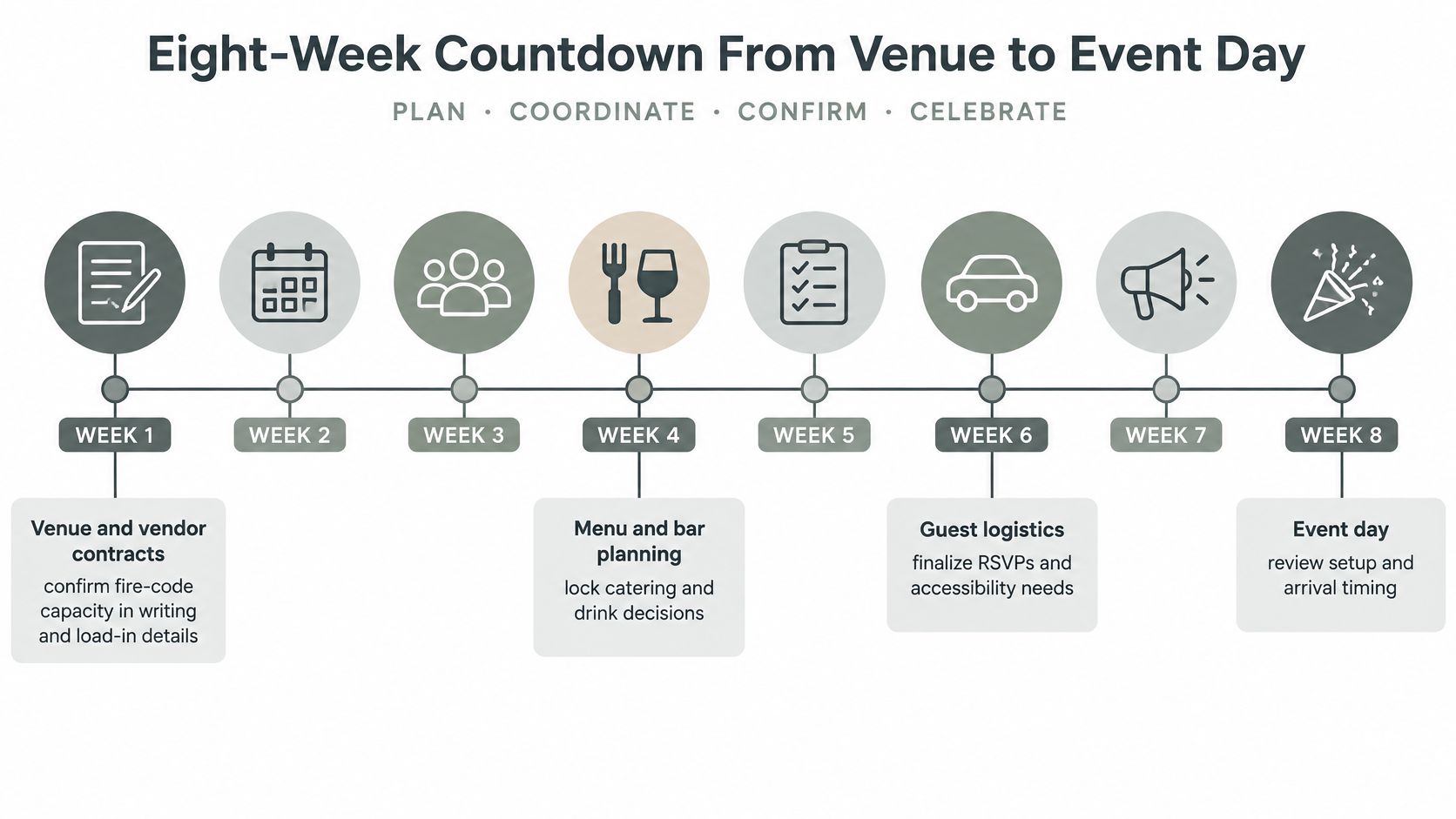
When | Task | Owner | Done when |
|---|---|---|---|
8 weeks out | Set objectives, budget and target headcount | Event lead | Budget approved by finance |
7 weeks out | Tour venues and sign the venue contract | Event lead | Contract signed with capacity in writing |
6 weeks out | Send save-the-date and employee poll | Communications owner | Poll answers cover most of the team |
5 weeks out | Book caterer, entertainment and transportation | Event lead | Vendors confirmed in writing |
4 weeks out | Send invitations with RSVP deadline | Communications owner | RSVP link live and tracked |
3 weeks out | Collect dietary and accessibility intake | Event lead | Dietary list complete and shared with caterer |
2 weeks out | Finalise run-of-show and risk register | Safety contact | Run-of-show signed off by all owners |
1 week out | Reconfirm headcount and vendor arrival times | Event lead | Final count sent to caterer |
Event day | Walkthrough and check-in setup | All owners | Incident log open and contacts posted |
Check the Venue Contract Like an Operator
Get the fire-code capacity in writing. Marketing capacity and legal seated capacity aren't always the same number. Confirm load-in and load-out times, kitchen access if you're bringing outside catering, and electrical capacity for AV and lighting.
Read the cancellation schedule before you sign, not after leadership changes the date. Ask whether a room can be closed off as a quiet space, whether overtime is charged by the hour, and who pays if the evening runs late. Ask where coats, gifts, and mobility devices go. Boring questions prevent expensive surprises.
Use the venue consultation to lock four answers: the pricing structure and minimum spend, whether a specific room can be held for an evening event at your headcount range, how catering and transport are handled, and whether a separate quiet room is available. Bring your headcount range, per-attendee budget, and preferred dates. At Freeform House, prospective members can book a personalized consultation to learn about pricing structures and membership, and the Hall of Fame Room can be booked for evening events. Write each answer beside the matching line in your budget table before signing anything.
Pin Vendors Down on Substitutions
Confirm each vendor's final guest count deadline in writing. Ask what happens if a dish, performer, or vehicle becomes unavailable, who approves the substitute, and whether the price changes. Confirm staff-to-guest ratios for your chosen format, because one bar station for a large crowd creates the line everyone remembers.
Caterer: Final count date, dietary production process, staff arrival time.
Bar service: Staffing level, service stop time, nonalcoholic selection.
Entertainment: Setup needs, backup plan, overtime rate.
Transportation: Pickup location, last ride time, contact number on the night.
Build the Run-of-Show in 15-Minute Blocks
Map arrival, welcome, meal service, recognition, optional activity, and close in 15-minute blocks, with one named owner per block. Keep one shared document with the run-of-show, contact list, and vendor arrival times. Nobody should work from an old email thread.
Set calendar reminders now for the final headcount push and the venue walkthrough. Both are easy to miss in December. Book the consultation in week eight so the venue is locked by week seven, and compress later weeks if you must. Don't skip them in a different order and call it compression.
Venue Layout and Programming for Mixed Crowds
A high-energy party is not automatically a high-engagement party. Loud music, forced mingling, and one packed room reward the guests who were already comfortable and push everyone else toward the exit. Zone the floor before you theme the night.
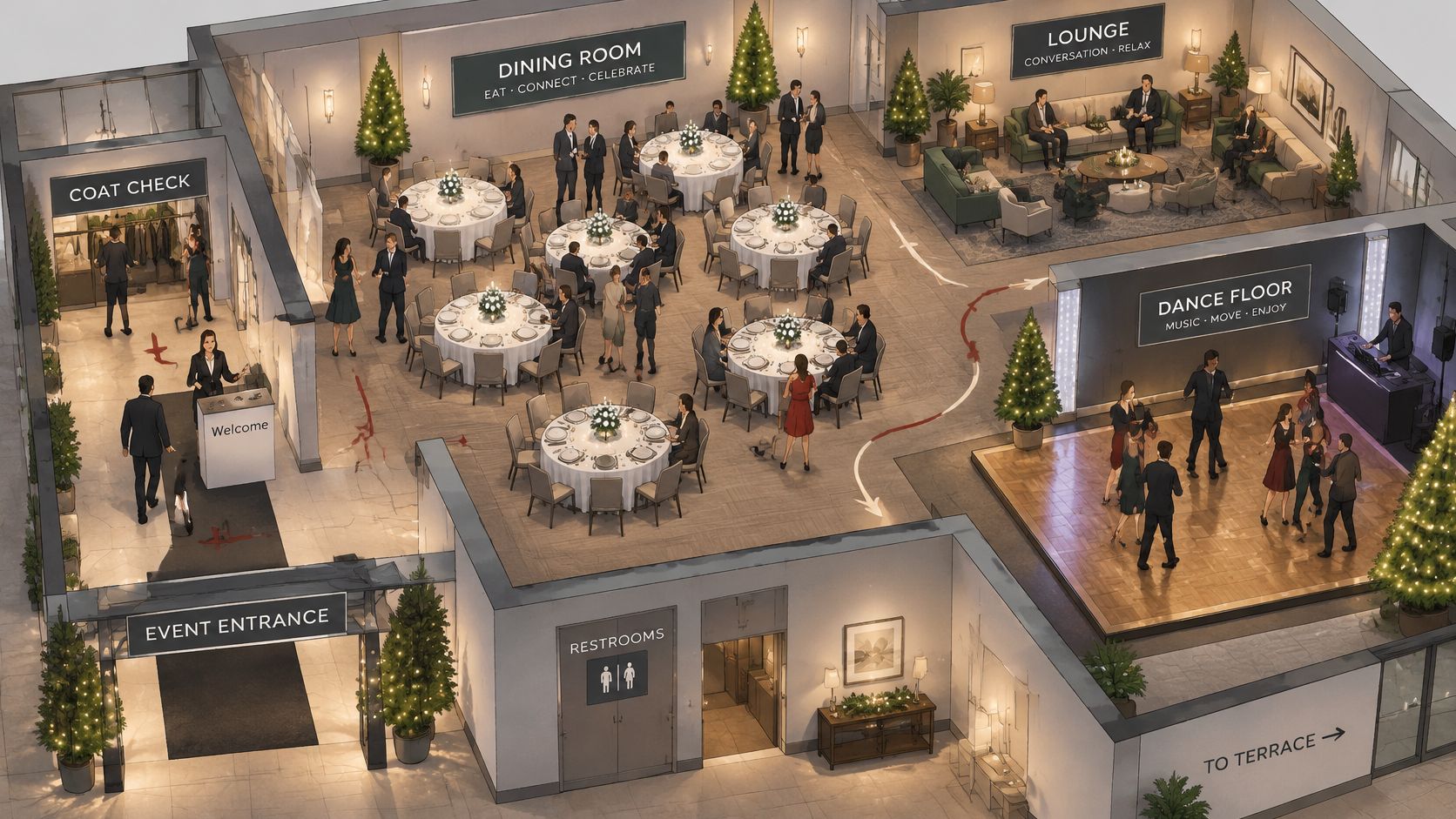
The inclusion gap is documented, not hypothetical. Only about two-thirds of U.K. employees felt workplace socials accommodated introverts, and nearly one-third said they did not accommodate neurodivergent workers, according to WorkLife's reporting on employee apathy toward the traditional holiday party. Design for different participation styles and you fix problems a theme cannot touch.
Plan Four Spaces Before the Program
A multi-room venue makes zoning far easier. Freeform House, a members' club in a 1920s-era downtown Jenks building, books the Hall of Fame Room for evening events and offers the Executive Room, equipped with a Jamboard, alongside private workspaces and reservable conference rooms, so quiet space and program space do not have to share one wall. Whatever venue you book, our guide to venue requirements for an event covers the questions to ask before you commit.
Divide the floor into at least four functions:
Welcome area: A named host greets people who arrive alone and points them to food, seating, and the schedule. Arriving solo is the highest-dropout moment of the night, and a host costs you one person, not a budget line.
Dining room: Tables sized for conversation, with enough clearance for servers and mobility devices to move at the same time.
Quieter room: Lower light, softer sound or none, and seating that faces nothing in particular. Give it a real room or a screened-off area, because a hallway chair reads as exile.
Programming space: Speeches and optional activities happen here, not everywhere at once, so guests can opt out by staying where they are.
Publish the guest-facing schedule in the invitation and again at check-in. State when speeches happen and confirm that leaving afterward needs no explanation. That promise is what makes attendance possible for people with a long commute, a caregiver at home, or an early shift.
Program for Choice, Not Performance
Keep the recognition speech short, use a microphone, and provide captions where you can. Build one activity people can join or skip, such as a photo corner or a gift exchange. Skip any whole-room game that asks everyone to perform on cue, especially once drinks are out.
The short video below is a useful prompt for thinking through flow, pacing, and where guests naturally gather or stall.
Seat people for conversation without forced networking. Mix two departments per table if connection is the goal, then let guests move freely after the meal. Offer a host-led introduction for anyone who wants one, and stop managing their evening after that.
After the event, ask which formats helped people connect and which made participation harder, and count the quiet room's usage the same way you count bar spend. Next year's floor plan should rest on those answers and on psychological safety and participation choice, not on whoever cornered you near the bar.
Catering, Alcohol and Privacy Decisions
Catering is usually one of the largest lines after the venue, and it shapes attendance more than entertainment does. 64% of employees prefer selecting their own meal, and food and beverage spending rose 31% year over year to roughly $59 per attendee in a 2025 survey, according to CFO.com's holiday party spending report. Budget for choice before you budget for spectacle.
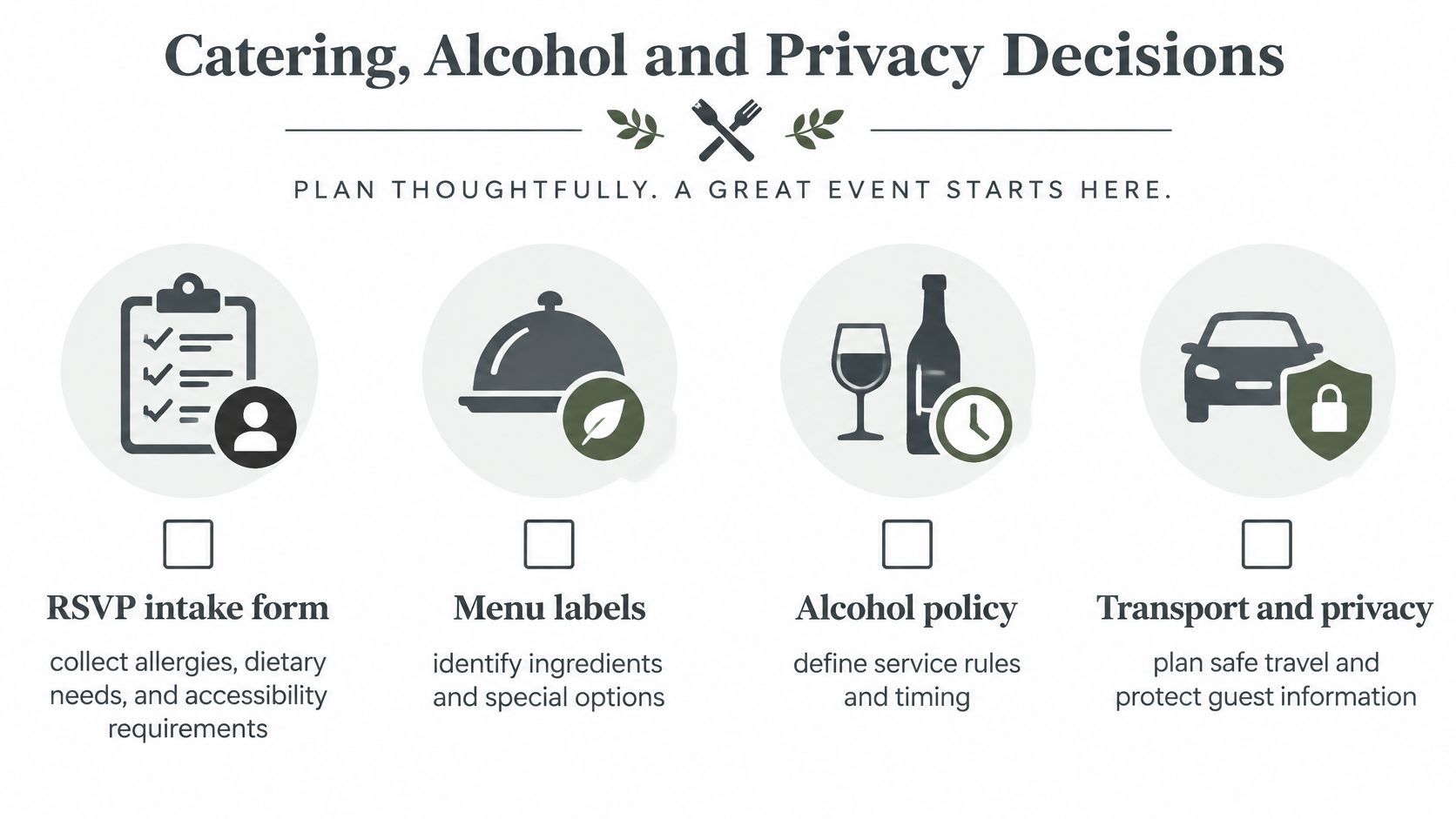
Give Guests a Real Meal Choice
Collect allergies, dietary needs, and accessibility requirements on a confidential intake form at RSVP. Share only what the caterer needs, in aggregate counts where possible, and name one person who can answer individual questions privately. Label every buffet or station item with ingredients and common allergens, keep serving utensils separate, and confirm final counts on a written production sheet.
Stations or a buffet with clearly marked options usually serve mixed crowds better than a single plated entrée. Guests control portions, timing, and when they rejoin a conversation. If you're weighing formats, our breakdown of how much private dining costs helps you judge whether plated service earns its premium at your headcount. Order proper alternatives either way. A side salad relabeled as the vegetarian main tells that guest exactly where they rank on your list.
Serve Alcohol Without Making It the Program
Plan for moderation as the norm. Some guests will drink lightly, some will abstain entirely, and the second group notices when the only nonalcoholic option is tap water. Offer substantial nonalcoholic drinks with the same care as the cocktails, keep food available throughout the evening, and set the alcohol service stop time when you book the bar, not during the event.
Treat the bar format as a budget decision with a risk attached. A hosted bar, a beer-and-wine selection, and drink tickets each trade cost against overconsumption differently, so pick one deliberately instead of defaulting to fully open.
Publish safe transport before invitations are accepted, not at closing time. Put rideshare credit instructions, taxi numbers, shuttle times, or a hotel block in the pre-event guide. Fund that line the same week you book the bar; the ride home is part of the alcohol plan. A guest who knows the ride plan early can decide about drinking before the first pour.
Spend on choice, reliable food, a safe way home, and privacy controls before you add another performer.
Put Privacy in Writing
Tell guests whether photography is happening, where images may be used, and how they can opt out without a public conversation. A simple colored lanyard or a note at check-in works. State how guest details from the RSVP form are stored, who can see dietary information, and when you'll delete it. Dietary data functions as health information, so restrict access accordingly.
Any imagery you use to promote or recap the event should show the actual people and place rather than anything that reads as clip art. Put the food, bar, transport, and photography answers on a one-page "what to expect" guide sent with the invitation. Nobody should learn your policy at the bar or in the coat check line.
Day-Of Safety Walkthrough and Post-Event Measurement
Write the risk register before event day, not during setup. List each hazard, name one owner, state the preventive control, and define the escalation route. It's a short document that stops three people from assuming someone else handled it.
The stakes justify the paperwork. 88% of employees drink at company parties and 20% report binge drinking, according to ClearStar's guide to managing risks at company holiday parties. Impairment controls are an operational requirement, so confirm trained bartenders can refuse service and that your service stop time is understood by every vendor.
Walk the Venue in Order
Assign three named roles and print their phone numbers on the run-of-show: event lead, venue or safety contact, and communications owner. Then walk the space before guests arrive.
Exits and capacity: Routes are marked and clear, and expected attendance fits fire-code capacity.
Access: Step-free entry, accessible restrooms and seating, and the quiet space is open and signposted.
Power and sound: Microphone, captioning, lighting, and backup batteries tested with the speaker present.
Vendors: Arrival times confirmed, loading route clear, final meal counts matched to the production sheet.
Weather and departures: Backup plan ready, rideshare pickup point agreed, emergency contacts posted backstage.
Our guide to event logistics management goes deeper on assigning these roles before vendors arrive. During the event, track check-ins against the RSVP list, meal counts, activity participation, and early departures. Early departures aren't failures by themselves. A pattern of them right after a loud program segment is useful information.
Log It, Then Survey Within 48 Hours
Record every incident and near miss in one shared log, including minor ones like a blocked doorway or a missing allergen label. Patterns only appear when small events get written down. Note the time, owner, action taken, and what you'd change.
Send a short survey within 48 hours using a 1 to 5 scale covering belonging, program quality, food, venue, and logistics. Ask one open question about what made participation easier or harder. Compare results with last year before changing the plan, and file the revised checklist while the details are still fresh.
If you're planning a corporate holiday party in Jenks or Tulsa and want distinct rooms for dining, conversation, and a quieter retreat inside a restored downtown building, book a consultation with Freeform House to talk through your headcount, dates, and room options. Bring your per-attendee budget and purpose statement, and we'll help you match the layout and hosting support to the event you're trying to run.
Comments