How to Improve Client Experience: A Practical Guide

52% of consumers leave a brand after a bad experience, so the most effective way to improve client experience is to remove friction before adding more technology. Make every interaction easier to understand, faster to complete, and more human when something goes wrong.
That conclusion runs against the way many businesses approach customer experience. They buy another platform, add another survey, or create another automated sequence. Meanwhile, a client waits for a reply, can't find the meeting room, repeats the same request to two employees, or leaves a polished event feeling overlooked.
In a small market such as Jenks and Tulsa, those failures travel quickly through personal networks. Client experience is shaped in the places where people meet, work, wait, collaborate, and ask for help. Digital systems matter, but the physical and social details often decide whether a relationship feels easy enough to continue.
The Hidden Cost of Friction in Client Experience
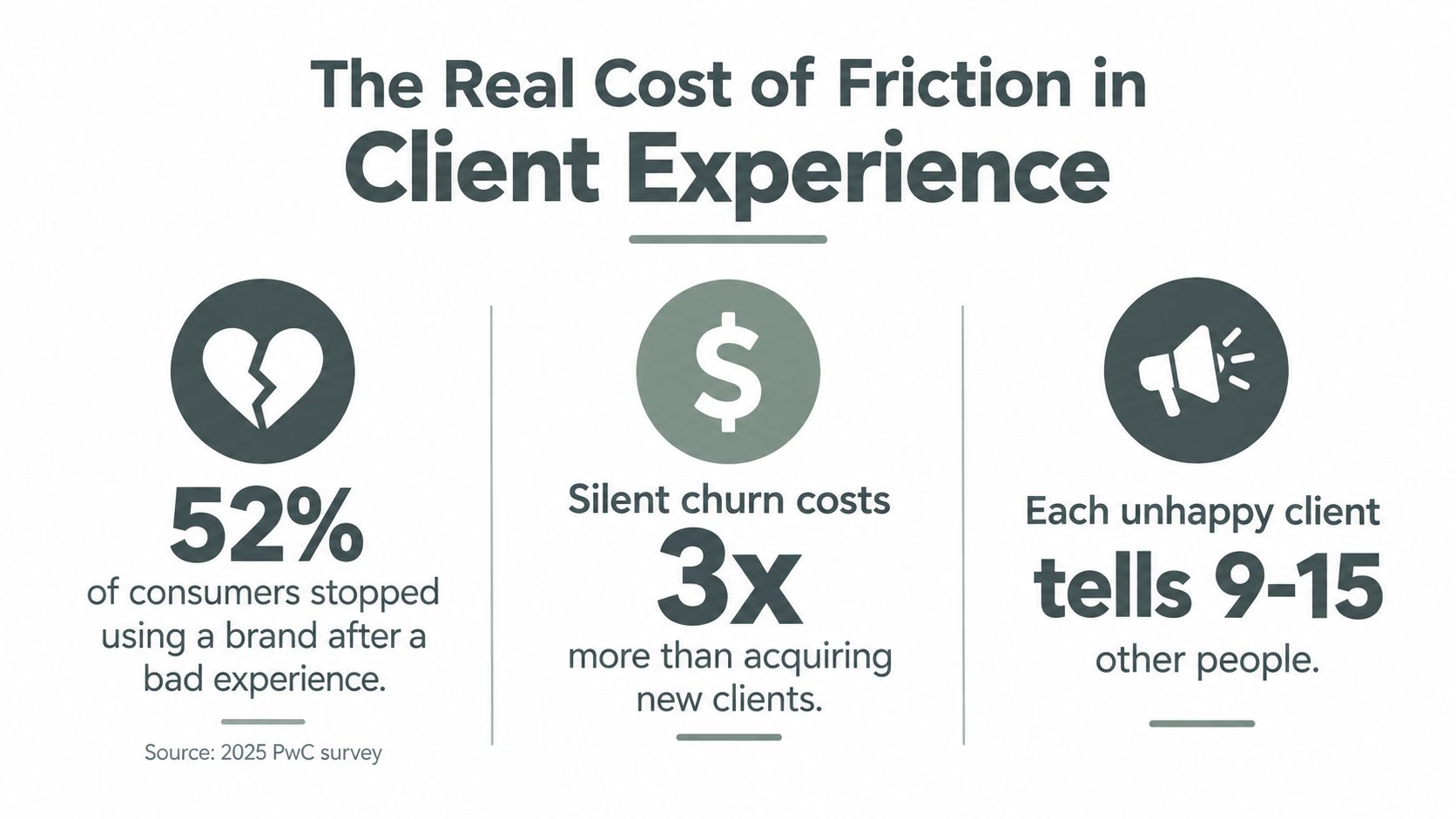
Client relationships rarely end with a formal complaint. A client stops booking, declines the next invitation, moves a meeting elsewhere, or recommends a competitor after an interaction made doing business harder than it should be.
PwC's 2025 Customer Experience Survey reported that 52% of consumers stopped using or buying from a brand because of a bad experience with its products or services, while 29% stopped because of poor customer experience online or in person. For a local operator, the cause may be ordinary: a confusing booking process, no host available on arrival, an uncomfortable meeting room, or follow-up that comes too late to help.
Friction is usually cumulative rather than dramatic. Several small obstacles can make a relationship feel expensive in time and attention. A missed detail before a meeting can make the whole visit feel disorganized. A slow response after an event can undo the goodwill built through personal contact.
Find the execution debt
Execution debt is the gap between recognizing a client problem and changing the daily workflow that creates it. A business may know that clients dislike repeating information or switching between platforms, yet leave the same handoff untouched for months. The problem is rarely a lack of another dashboard. It is an unresolved ownership or process decision.
Acxiom's 2026 CX report found that 58% of consumers still say it takes too much effort to engage with a business, and 73% are frustrated by moving between platforms for one task. A report can expose the pattern, but a person still has to redesign the handoff.
Practical rule: If a client has to ask who owns a request, your internal process is visible to them.
Start with the friction clients encounter repeatedly. Watch how someone schedules a visit, enters the building, finds the right person, receives the service, leaves, and hears from you afterward. Include the physical setting and the social handoffs. A polished event or premium coworking space cannot compensate for unclear ownership at reception or a follow-up that disappears.
Ask staff where requests stall. Read messages clients send when they are confused, not only surveys completed when everything goes well. Those messages reveal the points where people are doing work your business should have handled.
The goal is a less demanding next interaction, not a more elaborate CX strategy. Fix the handoffs clients feel first.
Mapping Your Client's Actual Journey
You can't improve a client journey that only exists in an internal process document. Businesses tend to map what employees do, such as “send confirmation,” “prepare room,” and “follow up.” Clients experience something else: uncertainty, waiting, reassurance, attention, and the confidence that someone has thought through the details.
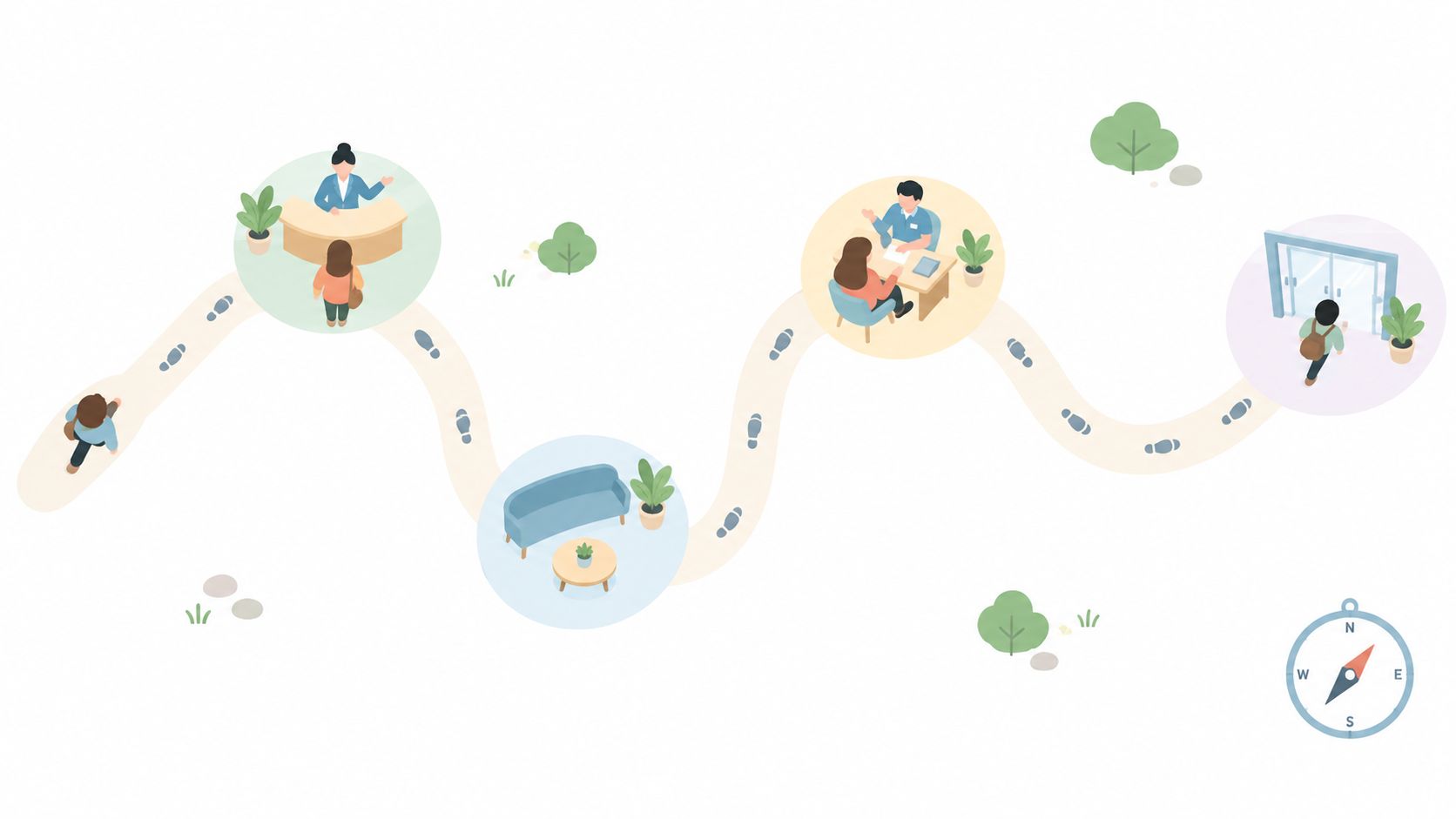
Map the journey from the client's point of view. Use a local entrepreneur traveling from Tulsa for a meeting, a remote professional arriving for focused work, or a team attending a private event in Jenks. Follow the physical route as well as the digital one, and write down what the client needs to know at each moment.
Start before the client arrives
Pre-arrival clarity answers the questions clients shouldn't have to ask. Where should they park? Which entrance should they use? Who will greet them? What should they bring? What happens if they arrive early? Put those answers in the confirmation message, and write them for a person who has never visited the space.
The welcome begins outside the formal service. A client who walks into an unclear lobby has already started working to obtain help. Make the first human contact deliberate. A greeting should identify the visitor, confirm the purpose of the visit, and explain the next step without forcing the client to narrate the entire appointment.
Observe the core interaction
During the service moment, watch for transitions. Does the client know when the meeting has started? Can the host access the required materials without leaving the room? Does the space support the conversation, or does the furniture, noise, technology, or temperature compete with it?
For a coworking or membership environment, include both practical and social details. Coworking typically combines multifunctional work, learning, and social space with designated and undesignated seating, membership participation, shared facilities, classes, and events, as described in research on the coworking center. The client may be evaluating not just the room, but whether the environment helps them work and connect.
Treat the exit as part of the service
The departure should answer what comes next. Confirm any promised deliverable, explain how to request support, and make the next action obvious. A client shouldn't leave a productive meeting wondering whether they need to send notes, wait for an invoice, or contact someone else.
Then audit the follow-up. Send the useful item while the meeting is still fresh. Refer to the client's stated objective rather than sending a generic “checking in” message. If the relationship is ongoing, record the preference or decision that will prevent the client from repeating it later.
Use a simple audit sheet with five columns: touchpoint, client question, current response, friction observed, and owner of the fix. Walk the journey yourself, then ask a colleague to do it without coaching. The gaps they notice will usually be more valuable than another abstract satisfaction score.
Giving Your Team the Authority to Resolve Issues Fast
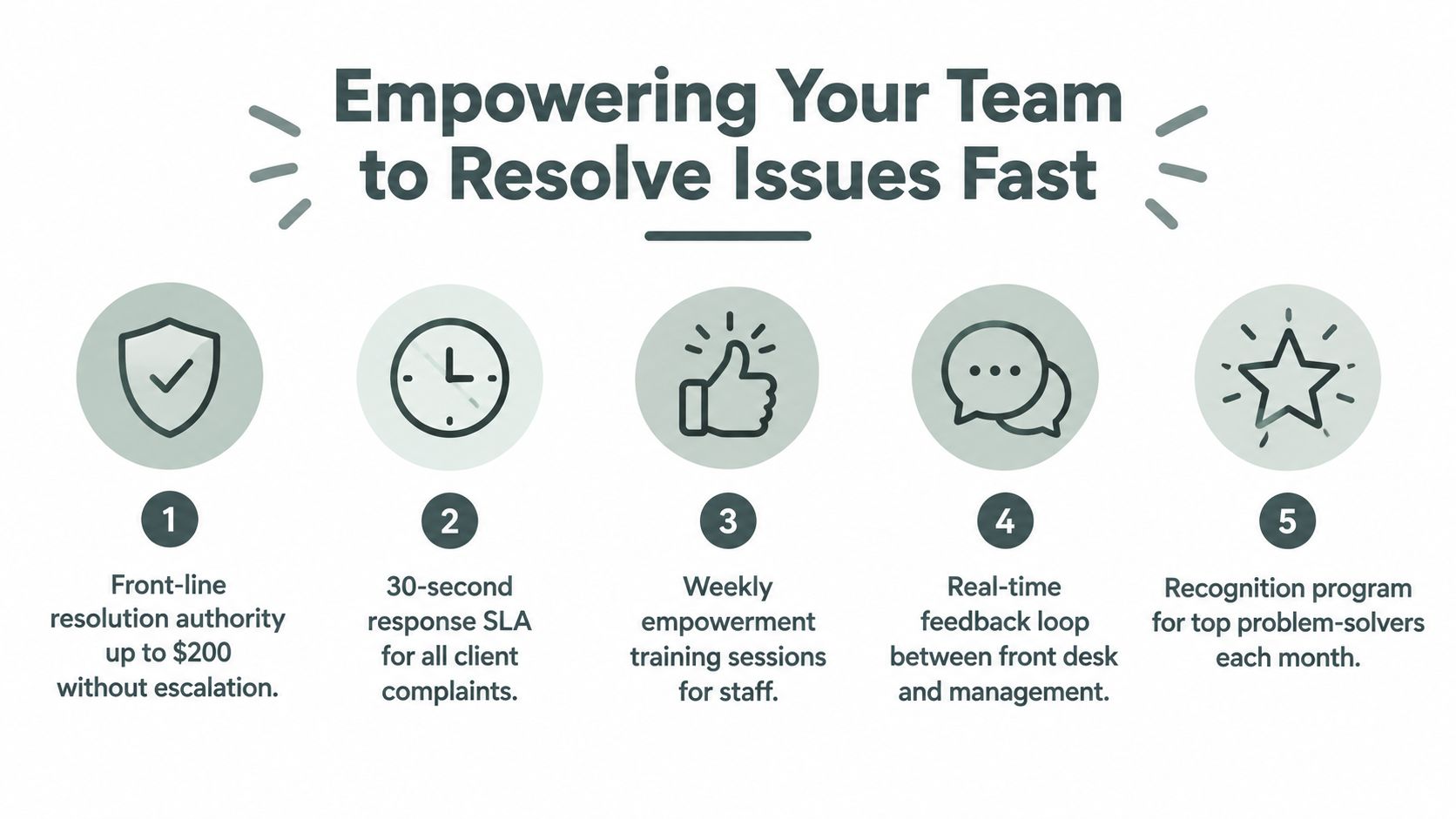
A polite employee who cannot fix a routine problem still becomes a barrier. Clients do not experience your org chart. They experience whether the person in front of them can take responsibility, access the right information, and move the issue toward a decision.
Research on employee empowerment and service quality consistently finds a positive relationship between frontline discretion, service quality, and customer satisfaction. The practical point is simple: give staff clear boundaries and enough authority to act without sending every small request to a manager.
Clients should not wait while an employee seeks approval for a routine adjustment, checks basic information, or tracks down the person who owns the answer. In a small local operation, that delay is felt immediately because the same people often meet clients at reception, in a meeting room, or at a community event.
Give staff usable language
Scripts should sound human. Their job is to remove hesitation when a client needs ownership, not to make every conversation identical.
For a delayed response: “I can see why you followed up. I'll take ownership of this now and tell you the next step before we finish this conversation.”
For a room or scheduling problem: “This setup isn't what you were promised. I can move the meeting to another suitable space, and I'll stay with you until it's ready.”
For an issue outside the employee's authority: “I can't make that decision myself, but I can bring in the right person now. You won't need to repeat the situation.”
For a service recovery: “You shouldn't have had to spend time sorting this out. Here's the correction I'm making, and here's when you'll receive confirmation.”
Each statement acknowledges the problem, names who is taking responsibility, and gives the client a next action. It also stays within a promise the employee can keep.
Build a clean escalation path
Set rules for what staff can resolve immediately, what requires a manager, and what needs specialist attention. Give frontline employees access to booking details, room status, membership information, and approved service policies. The software matters less than whether the employee can see enough context to act.
Chat and messaging often receive the first report of a problem. A 2026 CX data summary reports that 45% of inbound service interactions occur through chat and messaging, compared with 32% through self-service, 18% by phone, and 5% by email. The same source reports that 81% of customers want faster service than they did a year ago, and 73% expect personalization based on prior interactions in its customer experience statistics overview.
A fast handoff beats a long automated exchange that reaches the wrong conclusion. The receiving employee should get the conversation history, the client's stated need, and the action already attempted. That prevents the client from repeating the story, whether the issue began online or during an in-person meeting.
Short wait times matter, but speed without resolution only shifts frustration to another channel. Train employees to close routine issues at first contact, then make human escalation visible when a situation is unusual, sensitive, or still unresolved.
Choosing Premium Venues for Better Meetings
A meeting venue can strengthen or weaken the client relationship before the discussion begins. A cramped home office, noisy coffee shop, or improvised conference corner makes serious work feel temporary. A well-run venue gives the conversation space to develop, especially when the meeting involves a proposal, executive discussion, workshop, or sensitive planning.
For a Tulsa consultant meeting a prospective client in Jenks, the experience starts at arrival. The client notices whether the address is easy to find, whether someone expects them, whether the room is ready, and whether the setting supports concentration. Those details do not replace good work. They help the client see its quality.
This is the physical and social side of client experience that digital tools cannot provide. A premium coworking space can serve as a useful third space between the client's office and yours, giving both sides a neutral setting with a professional standard.
Choose the room for the outcome
Freeform House is a premium, members-only club and workspace created by freeform to rejuvenate Main Street America from downtown Jenks and Tulsa. It occupies a restored 1920 building and provides a three-story, 10,000-square-foot hub that combines historical character with modern functionality. Its place-based approach fits the mission of Main Street America to strengthen older and historic downtowns and neighborhood commercial districts.
Choose the room according to the work. A leadership conversation needs privacy and a calm layout. A workshop needs surfaces for shared thinking and enough space for movement. A client presentation needs reliable connectivity, controlled sound, and a setup that keeps attention on the people in the room.
The available rooms create a practical menu. The Hall of Fame Room, Freeform Room, Executive Room, and Thomas Room can support different meeting formats. The Rise loft studio and in-house podcast booth extend the venue to content production, interviews, and recorded conversations.
The trade-off is simple. A premium venue adds planning and expense, so use it when the setting affects trust, focus, or participation. Routine internal calls may not need it. A proposal meeting, working session, or relationship-building event often does.
Make hospitality part of the agenda
A premium meeting improves when the host removes avoidable decisions. Arrange the room before arrival, confirm the equipment, provide a clear welcome, and make food or coffee available without interrupting the conversation. Curated partnerships with local restaurants and coffee shops can support meals and beverages on demand, while package lockers and rentable transportation help clients manage the rest of their day.
Use a simple hosting script:
Set expectations before arrival. Explain the route, meeting purpose, room, schedule, and anything the client needs to prepare.
Welcome with context. Confirm why the group is there and introduce anyone the client has not met.
Protect the working session. Manage food, technology, and room changes discreetly instead of making the client handle them.
Close with decisions. Summarize owners, next actions, and timing before people leave.
Polished surfaces alone do not create a premium meeting. Considered service does. Authentic visual content and real settings build more credibility than staged scenes, as guidance on authenticity in advertising explains. Clients remember whether the environment felt considered and genuine, not whether every detail looked manufactured.
Building Sustainable Feedback Loops
Feedback becomes useful only after someone can act on it. Asking a client whether a meeting went well, then sending the answer into an unassigned inbox, creates the appearance of listening without changing the experience.
Build feedback into the natural close of an interaction. Ask one precise question while the client is still present: “What made today harder than it needed to be?” For a follow-up message, ask whether the next step is clear and whether the client knows who owns it. These questions reveal effort and ambiguity more effectively than a broad request for a rating.
Turn comments into operating changes
Review feedback at a consistent staff meeting and sort each item into three categories:
Remove: an unnecessary form, repeated question, or avoidable approval.
Clarify: an instruction, confirmation, room direction, or policy that clients misunderstand.
Own: a request that currently moves between employees without a clear responsible person.
Assign each change to a named employee and set a review point. A useful feedback loop has four parts: capture the observation, classify the friction, change the workflow, and check whether the same complaint returns. Without the third step, feedback is only documentation.
Frontline employees should contribute to this review. They hear the hesitation in a client's voice, see where visitors pause, and notice which requests require repeated explanation. Their observations often expose problems that a digital form misses.
Track operational signals rather than collecting every possible metric. Measure how long a request waits before someone owns it, whether the client received a clear next step, and whether the issue required repeated contact. Pair those observations with direct client comments so the team can distinguish a one-off preference from a recurring process failure.
Your support standards should also be visible to clients. Clear information about member support services helps establish what assistance is available and where to go for it. Clarity reduces the effort required to ask for help, which is often the first improvement a client notices.
The Human Edge in an Automated World
Automation is useful when it removes routine work. It fails when a client uses it to escape a problem and discovers that no person can take responsibility.
The 2026 State of Customer Experience report found that 42% of customers' expectations increased in 2026, while 51% say businesses still fall short when they need assistance. It also found that 78% will give up their preferred channel for a faster resolution. Channel preference matters, but resolution matters more.
That doesn't mean every interaction needs a phone call. A well-designed assistant can answer a straightforward question, surface a policy, collect the details of a request, or route a conversation to the right employee. The failure happens when the system treats containment as success even though the client's problem remains unresolved.
Design the handoff before the automation
A human escalation path should be easy to find and easy to use. Tell clients when a person will respond, pass the full context to that person, and avoid forcing the client to repeat information already supplied. If the automated system can't answer confidently, it should say so and move the request forward.
The report found that 69% of customers who prefer human agents would switch to automation if it could fully resolve the issue, while 42% say access to a human matters more than speed when using automated service. Those figures point to a sensible division of labor. Use automation for certainty and convenience. Use people for judgment, exceptions, reassurance, and recovery.
A local business has an advantage here because its strongest experiences can happen face to face. A host can notice that a visitor is looking for direction, introduce two members who could help each other, or adjust a meeting setup before anyone complains. A phone conversation can also feel personal when the employee has context and authority instead of reading a rigid script.
Use technology quietly
Technology should reduce the mundane work around the relationship. It can organize bookings, retain preferences, summarize a previous conversation, notify a host of an arrival, and make the next action visible to staff. It shouldn't make a member search through a maze to reach the person who can help.
A business concierge model can make that boundary practical. A resource such as business concierge service is valuable when it connects requests to a capable human rather than just adding another interface.
Clients don't need to know every system behind a smooth experience. They need to feel that the business remembers the context, respects their time, and stays accountable when the first answer isn't enough. In a high-trust setting, that human continuity is the feature automation can't supply on its own.
Freeform House offers members premium coworking, private offices, meeting rooms, event space, and creative facilities for client-facing work in downtown Jenks. Visit Freeform House to explore a setting where meetings, collaboration, hospitality, and community can make the client experience easier to deliver and easier to remember.
Comments