Cleanliness Standards for Premium Member Clubs

The most popular advice about cleanliness standards is also the least reliable: if a room looks clean, members will assume it is clean. In a premium club, that assumption creates a dangerous gap between polished presentation and actual hygiene. A clear table can still carry residue, a spotless restroom can still fail a surface check, and a perfectly staged podcast booth can become a high-touch contamination point within minutes.
Freeform House is envisioned as a premier, membership-based club in the heart of Jenks, Oklahoma's 10 District downtown. Comparable to the renowned SoHo House, it offers more than a social club. Members can use coworking spaces and a dynamic community hub built for collaboration and connection. That combination makes cleanliness a member-experience metric, not a background housekeeping task. The standard must protect historic character, premium finishes, creative equipment, food delivery zones, and the confidence people place in a shared environment.
Redefining Cleanliness Standards in Premium Workspaces
A tidy room communicates order. It doesn't prove sanitation.
The World Health Organization's hand hygiene guidance illustrates why visible presentation can't stand in for reliable practice. WHO reports average hand hygiene compliance in intensive care units was 59.6% up to 2018, with compliance at 64.5% in high-income countries and 9.1% in low-income countries. WHO also notes that low-income settings reach only around 9% during care of critically ill patients, while high-income countries rarely exceed 70%. Hand hygiene is only one cleanliness control, but the spread shows how difficult it is to turn a written standard into routine behavior at the point of use.
A private club has a different risk profile from an intensive care unit, yet the operational lesson transfers directly. Members move between meeting rooms, lounges, shared desks, restrooms, dining areas, lockers, microphones, and touchscreens. A visual walkthrough catches crumbs, smears, dust, and disorder. It won't reliably identify residual contamination.
A better definition of clean
For a premium workspace, cleanliness standards should answer four questions:
What must be clean: Define high-touch surfaces, food-contact areas, soft furnishings, floors, restrooms, equipment, and air-handling concerns by zone.
How clean is acceptable: Set method-specific acceptance limits where objective testing is appropriate.
Who verifies the result: Separate task completion from quality approval on higher-risk or heavily used areas.
What happens after failure: Reclean, document, investigate the cause, and adjust training or scheduling.
This approach also reflects the history of technical cleanliness. The development of ISO cleanroom standards began with ISO Technical Committee 209 in 1993, followed by the first ISO 14644 standard in 1999, ISO 14644-2 in 2000, and the cancellation notice for U.S. Federal Standard 209E on November 29, 2001. The important shift wasn't a particular classification for a club. It was the move from conflicting local rules toward consistent, measurable methods.
Operational rule: A room isn't ready because it looks finished. It's ready when the assigned process is complete, the relevant checks pass, and the result is recorded.
At Freeform House, that means preserving the warmth of a restored 1920 building and the comfort of an upscale members' club without confusing luxury aesthetics with hygiene assurance. Members should experience calm, order, and care. Staff should work from specific procedures that make those impressions repeatable.
Room-Specific Cleaning Checklists and Standard Operating Procedures
A generic checklist tells staff to “clean the room.” A useful SOP tells them which surfaces need what treatment, in what order, with which tools, and what could be damaged by careless work. A room-by-room program is essential in a club that combines executive meetings, creative production, dining, deliveries, and social events.
Hall of Fame Room and executive lounges
Start with a visual scan for spills, abandoned items, loose furniture, and maintenance issues. Remove waste and used serviceware before bringing clean supplies into the space. This reduces clutter and prevents clean materials from contacting refuse or food residue.
Use a product approved for finished wood on tables, consoles, and trim. Apply it to a microfiber cloth rather than flooding the surface. For upholstery, vacuum seams and edges with a suitable attachment, then spot-test any cleaner in an inconspicuous area before treating a visible mark. Don't use a strong disinfectant on leather, delicate fabric, or finished wood unless the manufacturer confirms compatibility.
Sanitize high-touch points, including door hardware, chair arms, light switches, remote controls, shared pens, presentation controls, and refreshment surfaces. Reset chairs to the approved layout, align tables, remove fingerprints from glass, and check that the room still feels lived-in rather than sterile.
For room layouts and furniture zones, staff can use the Freeform House room planning guide as a reference when assigning inspection points.
The Rise loft studio and podcast booth
Creative spaces need a gentler sequence. First, photograph or note the position of microphones, stands, headphones, cables, and movable accessories if the setup is configured for a scheduled production. Then remove waste and dust from exposed surfaces without pulling, twisting, or compressing acoustic treatments.
Microphone windscreens and shared headphones require a defined sanitation method compatible with the equipment. Wipe touchable exterior surfaces with an approved product and allow the manufacturer's required drying time. Don't spray directly onto microphones, mixers, sockets, controls, foam panels, or electrical equipment.
Manage cable clutter by lifting and routing cables rather than dragging them across floors or furniture. Vacuum around stands and beneath desks with care. Check the booth for food, condensation, and adhesive residue, since these small issues can affect both hygiene and equipment life.
Restrooms and dining delivery zones
Restrooms need a clean-to-dirty workflow, dedicated cloths, gloves, replenishment checks, and a final odor and appearance inspection. Clean sinks and counters, disinfect faucets and handles, treat toilet surfaces with restroom-specific tools, mop from the farthest point toward the exit, and keep the floor closed until it's safe.
Amazon Hub Lockers and curated dining areas deserve their own inspection points. Wipe locker handles and screens with a compatible product, remove packaging debris, clean food-contact surfaces according to the product label, and keep delivery traffic from crossing freshly serviced dining zones.
Training insight: Staff don't need a longer checklist. They need a checklist that reflects the materials, equipment, and member behavior in the room they're servicing.
Event Turnover Procedures and Frequency Schedules
Event turnover is where good intentions fail. A networking gathering leaves behind cups, food debris, shifted furniture, fingerprints, and a different air feel. Members arriving for focused coworking or an executive workshop shouldn't inherit evidence of the previous booking.
The first priority is containment. As soon as guests leave, the supervisor confirms the room is safe to enter, identifies spills or damage, and separates waste, reusable service items, and equipment. Staff should work from the perimeter inward, keeping the reset contained so adjacent members aren't exposed to noise, odors, wet floors, or carts blocking circulation.
The first hour after an event
Use a timed critical path:
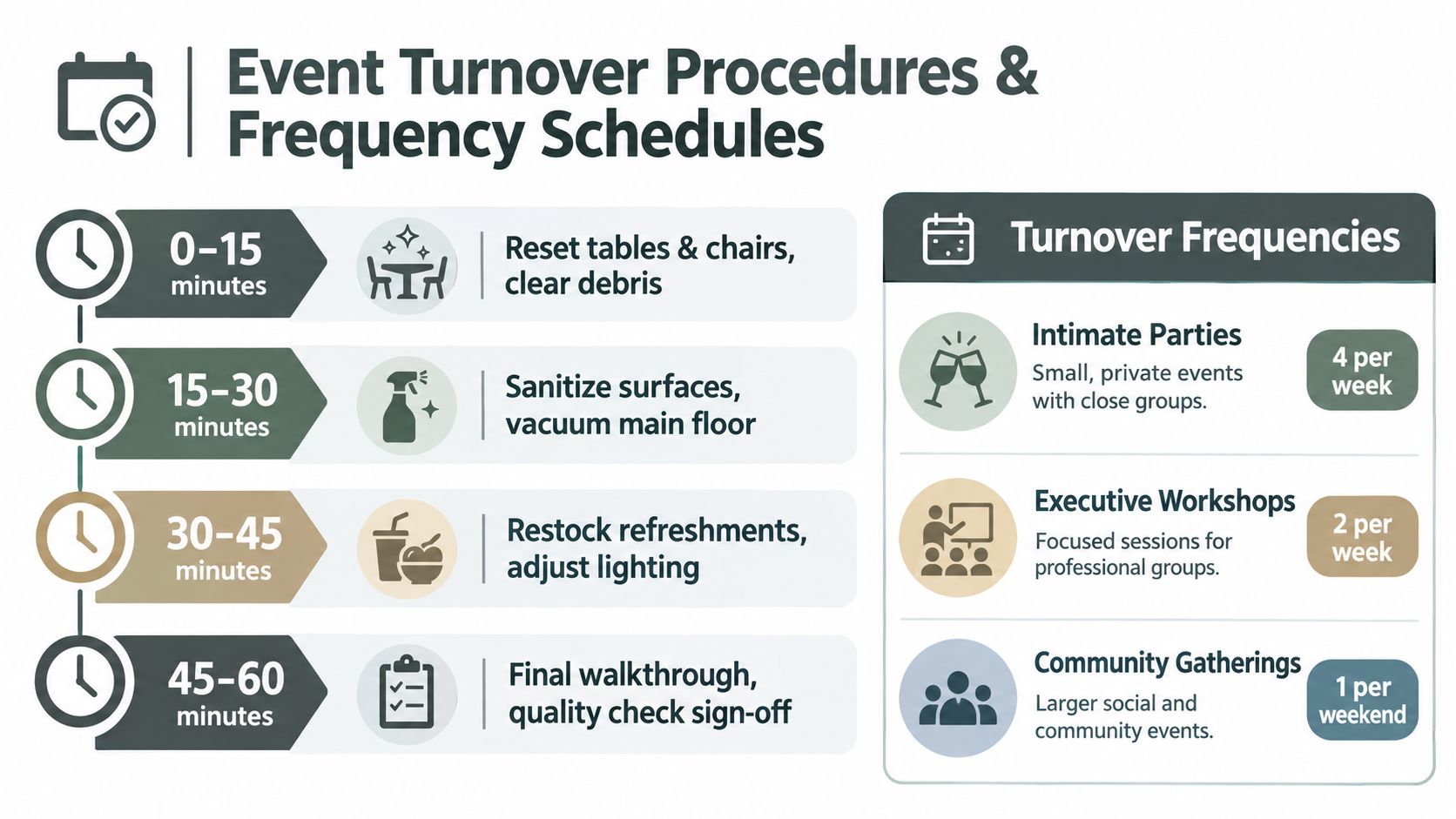
0 to 15 minutes: Reset tables and chairs, remove debris, collect serviceware, and isolate any damaged or stained item.
15 to 30 minutes: Sanitize high-touch surfaces and vacuum the main floor. Treat spills according to the floor and upholstery material.
30 to 45 minutes: Restock refreshments, return equipment to its approved position, and adjust lighting for the next use.
45 to 60 minutes: Complete a final walkthrough, confirm restroom and delivery-zone readiness, and obtain quality-check sign-off.
The supplied event turnover procedure chart gives supervisors a visual sequence for coordinating this work. The schedule should remain a control tool, not a promise to rush. A spill, broken glass, bodily-fluid incident, or equipment issue overrides the ordinary timeline and triggers the relevant incident procedure.
Frequency should follow use
An intimate party, executive workshop, and community gathering create different cleaning demands. Set a baseline schedule, then add use-based triggers:
Daily: Inspect public areas, restrooms, shared work surfaces, dining zones, entry points, and high-touch hardware. Replenish supplies and log defects.
Weekly: Deep-clean upholstery touchpoints, corners, under-furniture areas, acoustic-space edges, locker surroundings, and less visible fixtures.
Monthly: Review recurring failures, inspect finishes, check storage discipline, evaluate equipment condition, and update room-specific instructions.
Quarterly: Plan preventative treatments for carpets, upholstery, ventilation components, pest risks, water damage, and other building-maintenance concerns.
The event logistics management resource can support the wider booking workflow, but cleaning ownership must remain explicit. The event lead should trigger the turnover, the assigned technician should complete the work, and a supervisor or designated verifier should sign off.
Member-experience test: If a member can tell which event occupied the room last, the turnover is incomplete.
Air quality restoration deserves practical attention. Remove waste quickly, open or condition the space according to building policy, and avoid masking odors with heavy fragrance. A club should smell neutral and fresh, not like a chemical cover-up. If an event repeatedly creates odor, dust, or ventilation complaints, treat that pattern as an operational defect rather than adding more air freshener.
Approved Products, Staff Roles, and Objective Verification
Product choice affects hygiene, finishes, staff safety, and the member's sensory experience. A cleaner that works on a restroom fixture may damage wood, upholstery, acoustic foam, or a dining surface. Conversely, an overly mild general cleaner may remove visible soil without delivering the sanitation outcome required for a high-touch zone.
Build an approved-product register with the product name, intended surface, dilution instructions, contact time, storage location, PPE requirements, and safety data sheet. Staff should never improvise mixtures or transfer chemicals into unlabelled bottles. Eco-friendly products can support the club's environmental position, but “green” on the label isn't a substitute for surface compatibility, verified efficacy, or correct use.
Assign accountability by role
The cleaner owns the procedure and records what was completed. The shift lead checks exceptions, protects the schedule, and escalates damage or supply problems. The operations manager reviews trends, approves product changes, and decides when a room needs maintenance rather than another cleaning pass.
Training should be practical:
Demonstrate the sequence in the actual room.
Show the difference between cleaning, sanitizing, and disinfecting.
Practice contact-time discipline.
Teach cloth separation and safe waste handling.
Have staff explain why a product is prohibited on a particular finish.
Recheck technique after complaints or repeated failures.
Measure beyond appearance
Research on hospital surfaces demonstrates why visual inspection alone is weak. In a study covering more than 3,000 surface assessments across four hospitals, visual pass rates improved after cleaning, while ATP and microbiological failure rates did not change significantly. The HealthCare Surfaces Institute study used benchmarks derived from more than 5,000 cleaned surfaces, including ATP below 500 relative light units and microbial load below 2.5 CFU/cm² as pass criteria within that protocol.
Those values aren't universal club limits. They're examples of why a facility must define method-specific thresholds and validate them for the surface and regimen in use. ATP supports fast operational feedback. Culture or contact-plate methods provide more specific microbial information but take longer.
For defensible sampling, follow the CDC guidance on random surface sampling and contamination assessment. Sample representative high-touch zones, not only the spots everyone already suspects. Record location, surface type, time, product, result, corrective action, and follow-up result.
Verification principle: Use visual checks for presentation, ATP for rapid process feedback, and microbiological methods when specificity matters. No single method answers every cleanliness question.
Member Communications and Authentic Visual Branding
Members don't need a clinical lecture every time they enter a lounge. They do need confidence that the club controls its environment, responds to problems, and doesn't rely on appearances alone.
Communicate standards through quiet operational signals. A restroom sign can explain how to report a spill without displaying a wall of warnings. Onboarding materials can identify shared-space etiquette, microphone handling, food-zone expectations, and the club's approach to maintenance. Digital member updates should focus on useful information, such as a temporary room closure for deep treatment or a change in service access.
The tone matters. Say what staff do and how members can help. Avoid unsupported claims such as “germ-free,” “perfectly sanitized,” or “hospital-grade” unless the statement has a defined, appropriate basis. Transparency builds more trust than theatrical reassurance.
Make cleanliness visible without making the club clinical
A premium club should show care through composition and behavior. Staff can keep public-area check stations discreet, maintain attractive supply storage, and schedule noisier work away from peak member use. A completed room should show the result of care, not the tools used to produce it.
Photography must follow the same standard as operations. Guidance on authentic photography defines authenticity as close correspondence with reality, human creation, real light, traceable origin, and clear licensing. Basic edits such as exposure correction, cropping, white-balance adjustment, and dust-spot removal can preserve authenticity, while adding or removing major elements changes what the image represents.
Use natural light where possible. The UCSF photography standards recommend natural light and, when artificial light is necessary, indirect bounced light that mimics it. Photograph people working in genuine moments, not exaggerated cleaning scenes.
For room images, keep linens crisp, surfaces clear, and styling lightly lived-in with natural touches such as books or fruit. Don't leave cleaning bottles, carts, or process clutter in the frame unless the image is specifically documenting an SOP. Practical guidance for showing cleaning standards in photographs supports a finished, inviting look rather than a clinical one.
Finally, review realism. Independent imagery-policy guidance recommends checking grain, noise, edges, lighting, shadows, reflections, depth of field, and perspective. None of the pictures should look like clip art. They should look like real rooms, real people, and real moments at Freeform House.
Compliance, Recordkeeping, and Continuous Improvement
A cleaning log isn't paperwork for its own sake. It's the operating memory of the building. Without records, managers can't distinguish a one-off spill from a recurring failure in a particular room, shift, product, or event type.
Use a digital log with consistent fields:
Location: Room, fixture, surface, and service zone.
Task: Routine clean, event turnover, deep clean, inspection, or corrective action.
Owner: Staff member and shift lead.
Timing: Start, completion, and verification time.
Result: Pass, fail, deferred, or maintenance escalation.
Evidence: ATP result, culture result, photograph, incident note, or supervisor sign-off where appropriate.
Follow-up: Recleaning, repair, training, product review, or schedule change.
Maintain separate records for incidents, chemical inventory, equipment maintenance, member complaints, and supply shortages. A complaint about an odor should connect to the affected room, event history, ventilation check, and corrective action. A recurring upholstery stain may justify a fabric-care change or replacement budget. Records can also support a rational evaluation of equipment such as electrostatic sprayers, UV-C devices, or smart monitoring, without assuming that technology replaces trained staff or verification.
The matrix below keeps the recordkeeping system usable.
Verification Method | Frequency | Documentation Output |
|---|---|---|
Visual room and presentation inspection | After routine service and event turnover | Checklist, exceptions, verifier sign-off |
High-touch surface review | During each room service and public-area round | Zone log with missed-task corrections |
ATP surface testing | Risk-based sampling of representative high-touch areas | Surface location, RLU result, threshold decision, corrective action |
Microbiological sampling | When a validated protocol or investigation requires it | Sample record, laboratory result, response plan |
Random facility sampling | According to the site's confidence and risk plan | Sampling map, selected locations, trend report |
Chemical and equipment review | On the operating schedule and after product changes | Inventory record, safety documentation, maintenance status |
Complaint and incident analysis | Whenever reported, with periodic management review | Incident report, root-cause note, owner, closure date |
The CDC's sampling guidance is useful when a program needs statistics-based statements about sampled and unsampled areas, but the club should avoid claiming more certainty than its sampling design supports. Use the records to coach staff, refine room standards, schedule work intelligently, and show due diligence if a health-related complaint arises.
For broader facility controls, operators can also review relevant security features and access procedures, since cleaning records are stronger when managers know who entered a space, when an event ended, and which team owned the reset.
Freeform House offers members a restored downtown setting with coworking spaces, meeting rooms, creative resources, dining partnerships, and practical amenities designed for work, connection, and hosting. Visit Freeform House to experience how a well-run member club can combine polished aesthetics with cleanliness standards that are documented, measurable, and built around real use.
Comments