Flexible Office Space: How to Choose in 2026

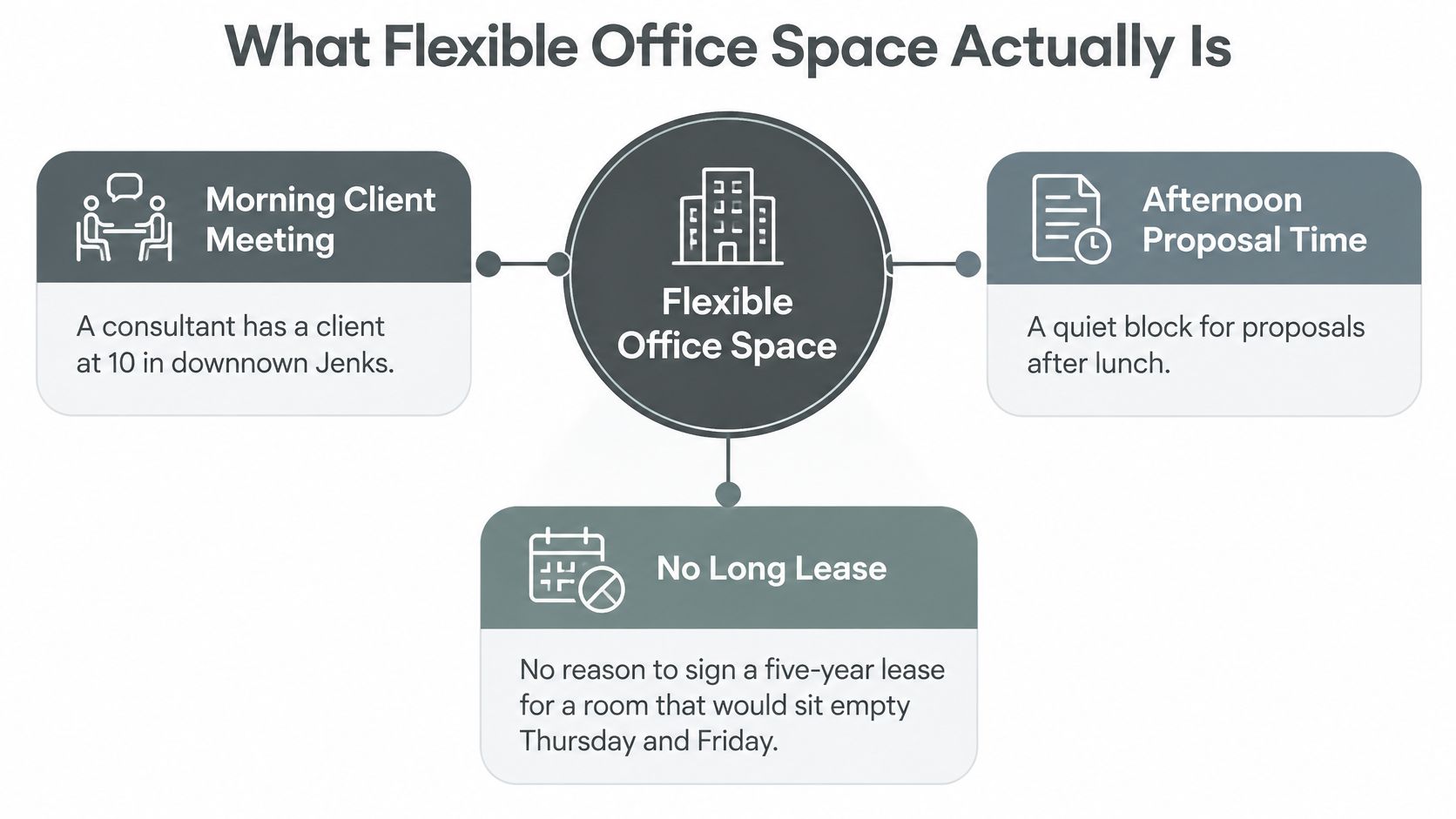
It's Tuesday in downtown Jenks. You've got a client coming at 10, proposals to finish after lunch, and no reason to sign a five-year lease for a room that would sit empty Thursday and Friday. You need somewhere professional to work, but you also need that space to fit a day that might change before breakfast.
That's the practical appeal of flexible office space. Choosing well means looking beyond a monthly desk price to the hours, privacy, and reservation rules that determine whether you can use it.
What Flexible Office Space Actually Is
Flexible office space is furnished workspace you can use without a multi-year lease, typically through a day pass, monthly membership, or short agreement, with desks, meeting rooms, Wi-Fi, and shared amenities already in place.
For the consultant in Jenks, that could mean reserving a closed room for the morning appointment, moving to a shared work area afterward, and leaving without taking responsibility for an entire office. The workspace operator manages the premises. The consultant buys access to the setting their work requires.
With a conventional lease, you rent a defined footprint whether you use it or not. You also take responsibility for arranging furniture, connectivity, and other operating needs, subject to the lease. That control can be valuable, but you're still paying for the room when everyone works elsewhere.
Flexibility describes access, not just a floor plan
An open room full of laptops is only one version of the model. Flexible offices can combine private rooms, shared desks, reservable meeting spaces, and sometimes access to multiple locations.
This isn't a pandemic invention: flexible-space leasing in major U.S. gateway markets grew at an approximately 45% compound annual growth rate between 2010 and 2018, according to Cushman & Wakefield's flexible-space report.
The practical distinction is between access to a building and access to the room you need. A desk membership doesn't automatically include a private office, unlimited meeting time, or permission to host an evening event.
The diagram follows the consultant's day, showing why different tasks can call for different spaces.
For Tulsa and Jenks professionals, the useful formats include:
Shared desks for independent work alongside other people.
Private offices for confidential calls, client work, and small teams.
Hybrid memberships for a changing mix of work, meetings, and gatherings.
Day passes and room bookings for occasional needs.
The right choice starts with how often you need a seat, a closed door, or somewhere to welcome another person. Those aren't interchangeable needs, even when they happen during the same workday.
Coworking, Private Offices and Hybrid Memberships
The formats differ in what stays available to you. A hot desk is a seat you choose when you arrive; a dedicated desk is reserved for you; a private office gives you a door. A hybrid membership combines access to more than one kind of space, while a day or meeting pass covers occasional use.
Format | What you get | Best for | Commitment |
|---|---|---|---|
Hot desk coworking | Open seat, shared amenities, Wi-Fi | Freelancers and occasional days | Day, week, or month |
Dedicated desk | Reserved seat in a shared room | Regular solo workers | Monthly |
Private office | Lockable furnished room | Client work and small teams | Monthly, sometimes short term |
Hybrid membership | Desk access plus rooms and member events | Executives and hybrid schedules | Monthly membership |
Day or meeting pass | One day or a booked room | Travelers and one-off meetings | None, or a small bundle |
A hot desk suits someone who arrives with a laptop and can work around ordinary conversation. Check whether you can leave for lunch and return to the same seat, or whether you'll need to find another one.
A dedicated desk removes that daily search. You keep a particular workstation, but still share the room's noise and activity. It works well when a consistent setup matters more than privacy.
Pay for the boundary your work needs
A private office gives you a lockable furnished room, with separation for calls, documents, and team discussion. You pay to reserve space rather than use an available seat, and the closed door can mean fewer spontaneous conversations with other members.
A hybrid membership combines different kinds of access. It can fit a schedule that changes week to week, as long as the included meeting time and guest rules match how you work. Membership access does not guarantee a conference room on a busy day, so check how reservations work and whether peak-day availability is limited.
For a traveler or occasional workshop host, a day or meeting pass may be enough. A single booking can cover a specific need without a recurring membership.
Compare quotes without inventing a local average
For a hypothetical budget exercise, compare about $500 a month for shared access with about $1,500 for a lockable office. These are illustrative inputs, not verified national averages or Jenks quotes.
Ask for a written local quote for the format and access you need. Compare the full week, not just the monthly price: a low-cost desk that is unavailable on your busiest day may be less useful than a higher-priced option with reliable access.
Separate the base charge from:
Printing and mail, which may require separate services.
Additional meeting hours beyond any included allowance.
After-hours access, if it is not part of the membership.
Guest access for clients, collaborators, or team members.
Choose for your most common week. If you only host a large meeting occasionally, booking a room for that day may cost less than paying for access you rarely use.
Benefits Beyond a Desk and Wi-Fi
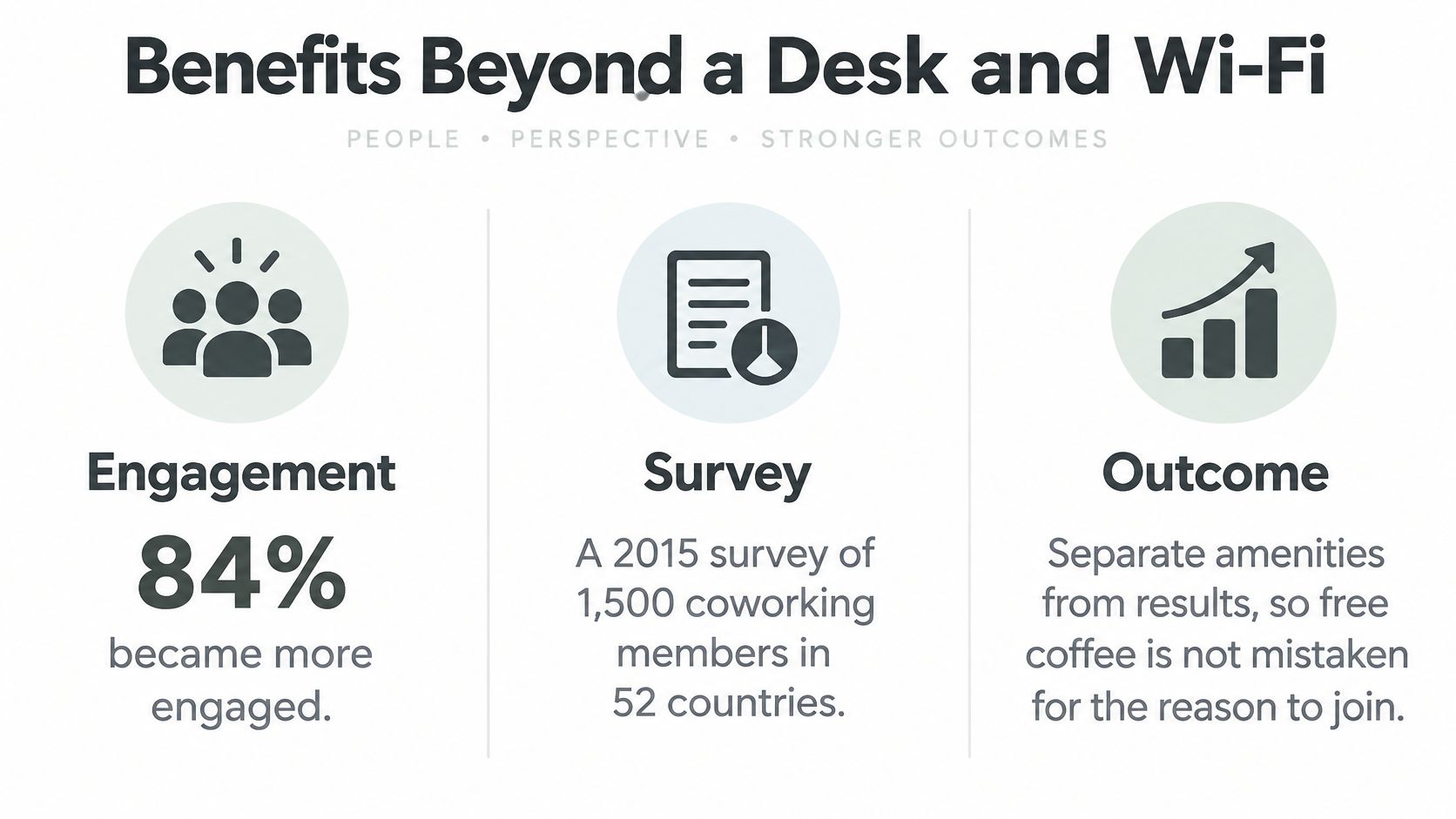
A 2015 survey of 1,500 coworking members across 52 countries found that 84% reported becoming more engaged and motivated, 82% reported expanding their business network, and 83% reported feeling less isolated, as documented in Knoll's coworking report. These are global, self-reported experiences, not a forecast for Jenks.
They do identify a useful distinction: amenities are things a space provides; outcomes are changes members experience. Coffee is an amenity. Having a productive conversation with another business owner is an outcome.
The visual below highlights that difference.
Translate the benefit into a workday
For someone working at a kitchen table, a separate workspace can create a useful boundary around concentrated work. For someone moving between cafés, an appropriate desk and accessible power can remove recurring distractions.
Client-facing work has different requirements. A deliberate meeting setting lets you control seating, presentation, and interruptions rather than apologizing for the background. Use an executive office amenities checklist to distinguish practical equipment from decorative extras.
A small team may need somewhere to review plans together without maintaining a permanent office sized for its busiest gathering. A creative professional may need daylight, a generous worktable, and somewhere to spread out materials.
A useful membership should make room for both a quiet hour and an easy introduction.
Community needs repeated contact
An attractive lounge doesn't create a network if members never overlap. A private office won't reduce isolation if you enter, close the door, and leave without meeting anyone.
Look for opportunities that fit how you participate:
Shared work periods let familiar faces become working relationships.
Hosted introductions help newcomers meet people without interrupting strangers.
Workshops and small gatherings give members something concrete to discuss.
There are limits. Open rooms can make deep work harder, and a busy social calendar can be irrelevant if every event conflicts with your schedule. Choose the combination of separation and contact that supports your work rather than assuming more activity is always better.
For another perspective on coworking and shared work environments, watch the video below.
During a tour, turn each promised benefit into something observable. Listen from the desk you'd use, inspect the meeting setup, and find out when members spend time together.
When the Hours Matter More Than the Address
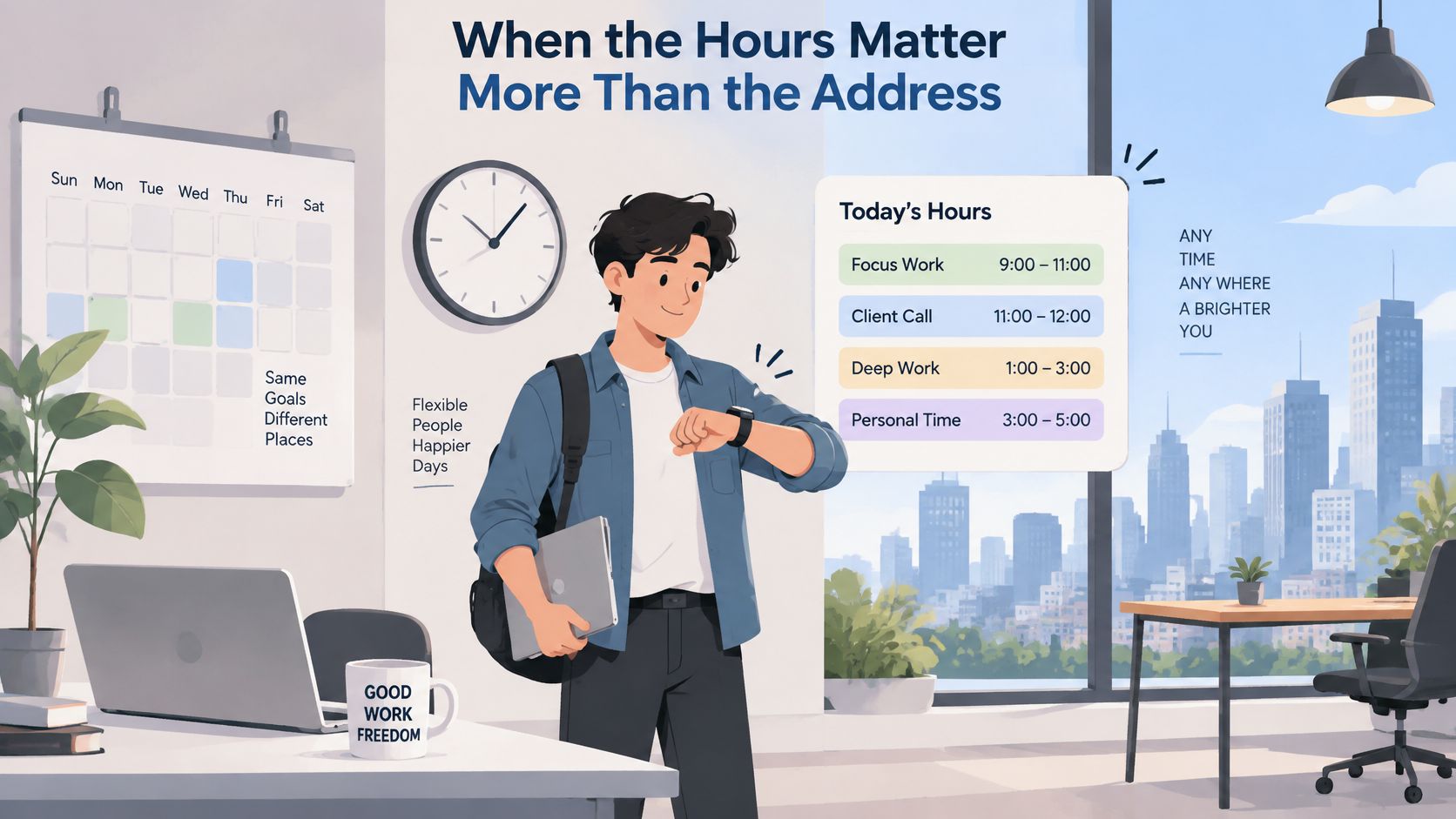
A workspace isn't meaningfully flexible just because you don't own the desk. If you can't enter when work needs doing, the short agreement solves only part of the problem.
In global findings published by JLL's occupancy benchmark report, 57% of office workers believed flexible working hours would improve their quality of life, while 49% currently had access to that option. Building access and employment policies aren't the same thing, but the gap makes working hours an important part of workspace selection.
A founder might work before a site visit. A caregiver might leave for school pickup and return later. An executive may need a private room between an afternoon appointment and a client dinner.
The useful question is whether the building supports those changes, not whether its address looks good on an invitation.
Test the entire day
Ask specific questions rather than accepting a general promise of flexible access:
Published hours: When can members enter, and when must they leave?
Early and evening access: Does your membership cover the times you need?
Security: How do credentials, guest entry, and after-hours assistance work?
Short-notice reservations: Can you book a room that morning, or is advance notice required?
Busy-hour calls: Are phone rooms realistically available around the start and end of your day?
Evening gatherings: Can workshops or small events use the building after desk activity slows?
A locked front door isn't a complete security arrangement. You also need to know how an invited guest gets inside and whom to contact if access fails.
Match the booking unit to the task
Sometimes you need a professional room for an appointment, not a desk for an entire day. Understanding office space rented by the hour helps you compare that short booking with a recurring membership.
Think of a gym membership versus a home treadmill. Access has value when you can show up at a useful time; equipment you can't use when needed doesn't solve the problem.
Don't assume building entry includes event permission, room access, or staff support. Those are separate conditions worth confirming in writing.
A tour should settle this question: Can this workspace adapt when your day shifts, or does it only offer another place to sit?
How to Judge a Space Before You Commit
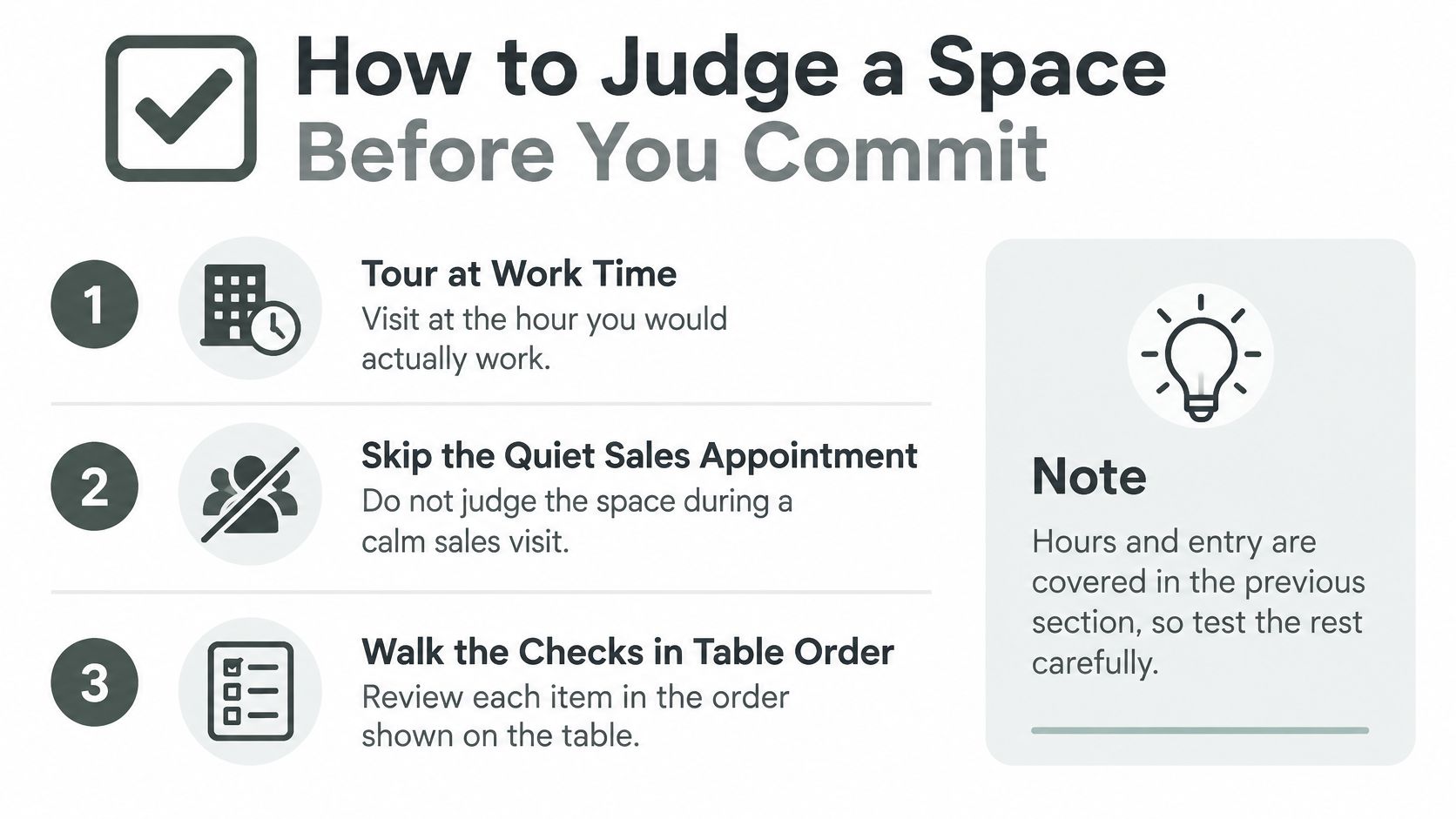
Tour at the hour you'd work. A calm sales appointment won't tell you whether nearby conversations interrupt calls or whether the meeting rooms are all occupied when your team arrives.
Flexible office pass or walk checks
Check | A pass looks like | Walk away if |
|---|---|---|
Hours and entry | Usable across your real day, including early or evening needs | Access ends before your calls or events |
Peak meeting rooms | A room you can book on your busiest weekday | Midweek rooms are waitlisted or availability is only verbal |
Privacy | A closable room for clients and sensitive calls | Only open desks or a shared booth are available |
Technology | Stable Wi-Fi and a working display for hybrid calls | Connectivity is best effort with no backup |
Contract | Clear notice, guest rules, and meeting-hour limits | A long lock-in or surprise room fees |
Total cost | Membership plus extras still beats an underused lease | The quote ignores parking, guests, or overtime rooms |
People present | Members overlap with your hours | The building is empty when you work |
Location | Drive, parking, and host access fit Jenks or Tulsa days | The commute cancels the time you save |
Test peak demand before average availability
According to JLL's occupancy benchmark report, global office utilization reached 56% in 2026, up from 49% in 2024. The report also found that 62% of organizations required a fixed number of in-office days, while 14% retained fully flexible approaches.
Those global figures don't establish local booking demand. They explain why an empty building during a tour isn't sufficient evidence that a room will be free when colleagues gather.
Request a room for your busiest weekday and preferred time. Check the reservation calendar, cancellation rules, and whether a recurring booking is protected or must be made afresh.
Use this visual reminder to keep the tour focused on working conditions.
Inspect the details people skip
Close the meeting-room door and listen from outside. A door provides separation, but it doesn't necessarily provide enough acoustic privacy for sensitive discussions.
Test the technology with your own laptop. Join a Zoom or Microsoft Teams call, connect to the display, and confirm how remote participants will hear people around the table. Ask what happens if the connection drops.
Read the agreement for notice periods, room-hour caps, guest permissions, and expansion options. Put the full membership cost beside the full cost of a small lease, including furniture, connectivity, parking, and the time spent traveling.
Treat two failed essential checks as a reason to keep looking. Missing nice-to-have amenities doesn't necessarily disqualify the format, but unreliable access or insufficient privacy can prevent you from doing the work you're paying to do.
How Jenks and Tulsa Weeks Actually Use It
Consider these hypothetical workweeks as booking decisions rather than descriptions of actual local members. Each calls for a different combination of access and space.
Solo work and a recurring team day
A solo bookkeeper uses a hot desk on a couple of mornings to avoid home interruptions. Client calls happen in a reservable booth, and a private office would add little because clients rarely visit. Format: hot desk coworking. Failure check: privacy, if the booth can't be reserved when calls occur.
An advisory team works remotely but meets each Wednesday to review accounts and prepare recommendations. The broader pattern is established: CBRE reported in 2024 that 80% of current office occupiers had adopted hybrid policies they intended to sustain. For this hypothetical team, the format is a recurring meeting-room booking; the failure check is peak-day room availability.
Teams comparing attendance patterns can use these practical hybrid work schedule examples to decide which activities need shared time.
Guests, production, and evening use
An executive hosting a Tulsa client needs a quiet room, straightforward parking, and somewhere appropriate to continue the conversation. An irregular calendar makes hybrid membership a possible fit. The failure check is location, including whether a first-time guest can arrive without confusion.
A photographer or podcaster needs controllable conditions, not a scenic lounge. Before booking, they test light, sound, power access, and permission to bring equipment. Format: day or meeting pass with explicit production permission. Failure check: privacy, especially if surrounding noise reaches the recording area.
A charity board or small celebration needs the building after daytime work ends. That's an event booking, not an automatic benefit of desk membership.
Format: A separately authorized room booking with appropriate event terms.
Failure check: Evening access that covers setup, guest arrival, and departure.
For professionals moving between downtown Jenks and central Tulsa, the best location is one they can reach between real appointments. A cheaper desk with a difficult drive can lose its appeal on the very day it's supposed to save time.
Pick the Membership That Matches Your Week
Before choosing a membership, map out a typical week: days you need a desk, closed-door meetings, client visits, production work, and any evening events. Then choose the smallest commitment that covers those recurring needs. A bookkeeper's routine may call for a different setup than an advisory team's schedule.
Calculate the cost of actual use
Use a written quote to calculate:
Effective cost per working day = total monthly workspace cost ÷ days you actually work there.
Include expected room overages and other necessary extras in the monthly total. Compare the result with day passes and the full monthly cost of a small lease, not just its advertised rent.
A membership does not have to be the cheapest option. You should be able to say what the added cost buys: for example, reliable access on peak days or hours that fit your working week.
A local option for a mixed week
Freeform House is opening in 2026 as a premium, members-only club in the heart of Jenks and Tulsa. It is more than a social club: a central gathering place that supports a creative, cooperative local community.
The three-story, 10,000-square-foot club offers private workspaces, open collaboration areas, hot desks, and reservable conference rooms. Members have access to three floors of curated spaces, with options for focused work, meetings, and collaboration.
Compare those options with the week you mapped out. Check hours, peak-day access, room availability, and agreement terms. A membership fits when it supports your actual routine, including any after-hours use you need, rather than just offering an attractive address.
Freeform House brings private workspaces, shared work areas, and reservable conference rooms together in downtown Jenks for professionals whose weeks don't follow a fixed office routine. Visit Freeform House to explore the club and compare its workspace options with your actual meeting schedule, guest needs, and working hours.
Comments