Exclusive Member Benefits at Freeform House Explained

You've got a client call in the morning, a package waiting somewhere across town, content to record, and a dinner meeting to arrange. None of those tasks is especially difficult, but each one creates a small interruption. By the end of the day, the interruptions can matter more than the work itself.
That's where exclusive member benefits become more useful than a simple discount or loyalty stamp. The strongest memberships combine access, convenience, workspace, and community into one experience. For local entrepreneurs, creative professionals, executives, and hosts in Jenks and Tulsa, Freeform House is envisioned as a membership-based club in the heart of the Ten District, designed to bring those layers together.
A Day Inside the Club
A local entrepreneur arrives mid-morning with a laptop, a production schedule, and a client presentation to finish. Instead of starting the day by searching for a quiet café, they pick up a latte through a partner coffee shop and settle into Freeform House, a restored 1920 building in downtown Jenks.
The first task is a focused call. A quiet room gives the conversation privacy without forcing the member to leave the building. Later, the entrepreneur moves into a meeting room for a strategy session, then records a podcast episode in the in-house booth while the discussion is fresh. Lunch comes from a curated restaurant partner and arrives at the member's space, so the team keeps working rather than breaking the afternoon into separate errands.
By evening, the same building has changed roles. The entrepreneur welcomes clients and collaborators for a small reception. The room feels more intentional than a rented office, but less formal than a hotel ballroom. Guests can meet the people behind the business, see the setting where the work happens, and experience the club as a place for connection.
One membership, several working modes
That day illustrates the difference between a standard coworking pass and a private-club model. A coworking pass generally answers one question: Where can I work? A layered membership answers several:
Where can I focus? In a room suited to a private call, presentation, or team discussion.
Where can I create? In a prepared studio or podcast space.
How can I reduce daily friction? Through food, coffee, package pickup, and local transportation conveniences.
Where can I bring people together? In a setting designed for meetings, events, and social interaction.
The value doesn't come from treating every amenity as a separate trophy. It comes from moving naturally between work, production, dining, and hosting. A member may use only one feature on a given day, but the broader access makes the club useful across changing schedules.
Practical rule: Judge a membership by how many real situations it supports, not by how long the benefits list looks.
What Makes a Benefit Truly Exclusive
An everyday loyalty perk is like a public park pass. It may offer a discount or reward, but many people can access the same basic experience. An exclusive member benefit is closer to a private club key. It opens a particular environment, service, relationship, or moment that isn't available in the same way to the general public.
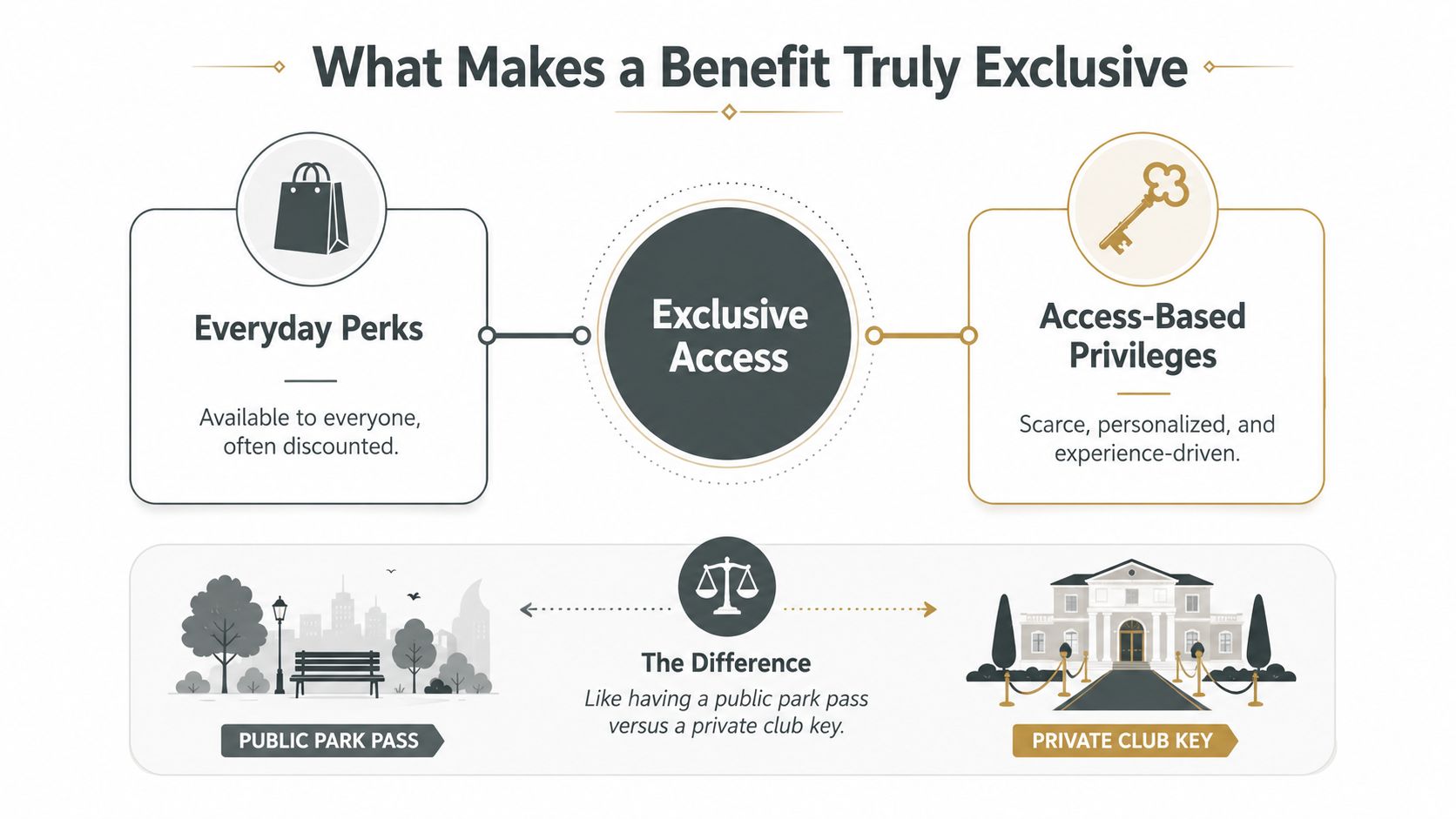
The distinction matters because exclusivity alone is weak value. A benefit becomes compelling when it does at least one of four jobs:
Saves time, such as handling food delivery, package pickup, or short local trips.
Expands access, such as providing a private room, production booth, or event setting.
Improves the experience, by combining thoughtful service with a more comfortable environment.
Signals belonging, giving members a place and community that reflect how they want to work and connect.
Consumers respond strongly to access-based perks. A 2026 consumer-loyalty summary reported that 58% of members consider invitations to exclusive in-store events important, while 54% say those invitations motivate enrollment; the same dataset found that 72% consider early access to sales important and 57% value the ability to jump the queue (consumer loyalty research). These findings point to a practical lesson: exclusivity works especially well when it gives people time, priority, or experiences they can't easily arrange themselves.
Perceived value matters more than the inventory
Members don't evaluate benefits as a flat list. They ask whether the full bundle justifies the dues. Recent membership research identifies monetary savings, exploration, and social benefits as strong value drivers, while recognition carries less weight, according to a review of membership value and renewal behavior.
That explains why a member may appreciate access to a studio even during a month when they don't record anything. The benefit still signals that the club understands their work and has infrastructure ready when an opportunity appears. But the signal can't replace practical utility. If members rarely use the spaces, services, or relationships, the membership may feel decorative rather than valuable.
The Four Signature Rooms
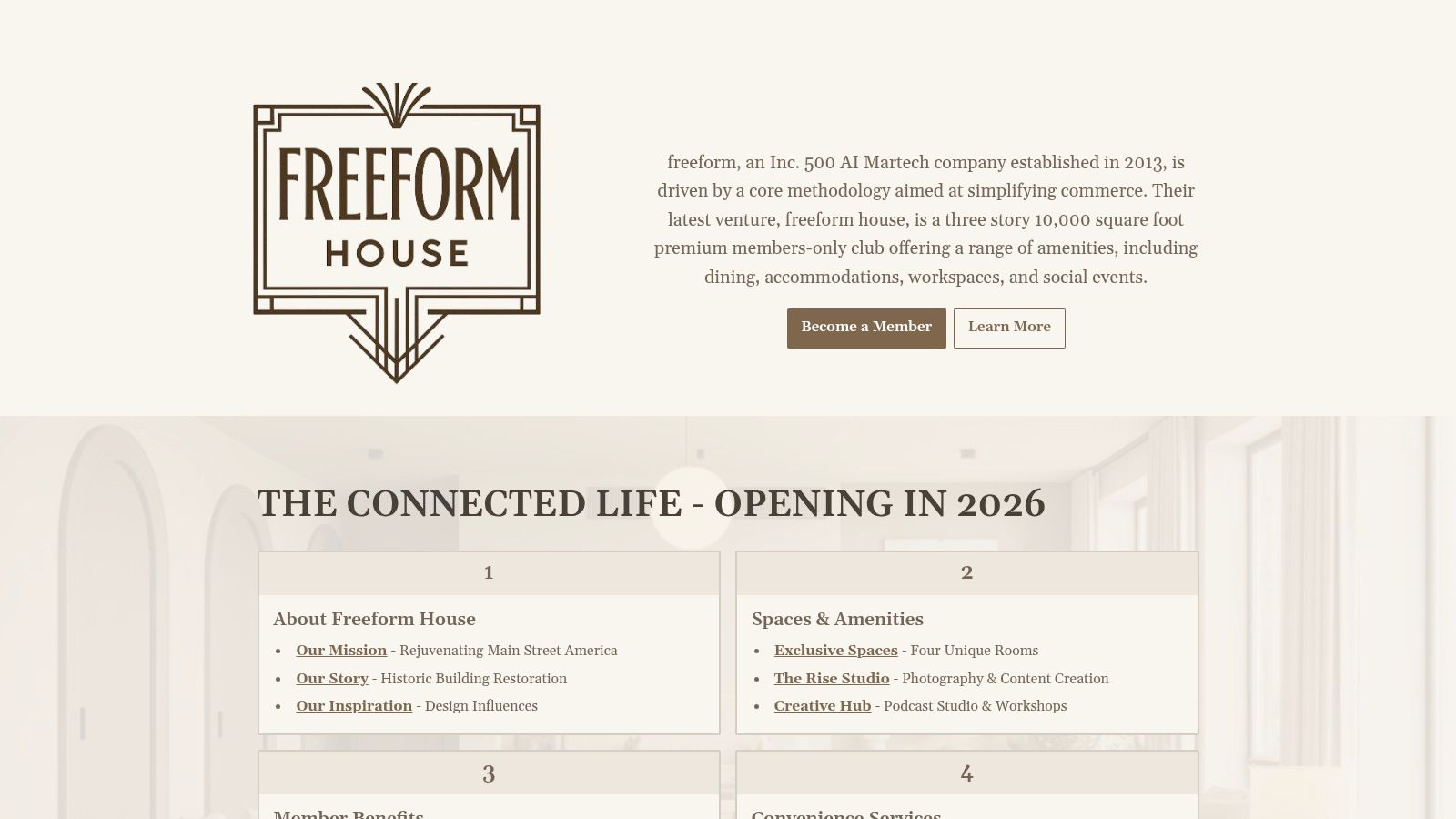
Freeform House's four signature rooms are designed for different working situations, not as interchangeable boxes. They're located inside a restored 1920 building in the Ten District, where historical character sits alongside modern workspace functionality.
Match the room to the work
The Hall of Fame Room suits a client-facing presentation or a gathering where the setting needs to feel memorable. It gives an entrepreneur a stronger backdrop for a pitch, a partner conversation, or a milestone meeting than an improvised table in a busy public space.
The Freeform Room is the flexible choice for collaborative work. Use it for a working session, a creative review, or a small team meeting where participants need room to exchange ideas rather than sit through a formal presentation.
The Executive Room fits conversations that require discretion and a polished atmosphere. An executive team can use it for sensitive planning, leadership discussions, or a focused meeting with an important client.
The Thomas Room offers another distinct setting for hosting and work. Its value is choice. A member can select a room that matches the tone of the occasion instead of forcing every meeting into the same environment.
Why four rooms are more useful than one large room
A single meeting room creates scheduling pressure and weakens the experience when every event has the same visual identity. Four differentiated rooms let members think about purpose first. A solo planning session, a board-style discussion, a client pitch, and a team offsite each call for a different balance of privacy, presentation, and atmosphere.
The right room changes how people participate. A focused room supports concentration, while a presentation-oriented room helps guests understand that the meeting matters.
The practical step is simple. Before booking, identify the audience, the desired mood, and the work that must happen. Then choose the room that supports those conditions rather than selecting whichever space happens to be open.
Creative Tools and Studio Access
A creator often loses momentum before recording begins. The lights need setup, the microphones need checking, the background needs attention, and the team needs somewhere to review the material afterward. A ready-made studio changes that sequence.
The Rise loft studio gives photographers, videographers, designers, and small brands a recurring production environment. Members can use it for portraits, product imagery, short-form video, campaign assets, or a brand shoot without turning every project into a search for a new venue. The in-house podcast booth provides a separate setting for interviews, educational episodes, founder conversations, and client content.
Treat production space as infrastructure
The best way to use these creative benefits is to build them into a repeatable workflow:
Plan the output first. Decide whether the session is for photography, video, audio, or several formats.
Reserve the appropriate space. The loft studio and podcast booth serve different production needs.
Batch related work. Record several episodes, capture multiple product angles, or produce a set of social assets in one visit.
Use the club for the follow-through. Move into a meeting room to review edits, plan distribution, or discuss the next campaign.
This structure reduces coordination between separate studios, offices, and meeting venues. It also gives a small business a professional setting without requiring the owner to purchase, store, and maintain every piece of production infrastructure.
A content creator who normally records at home may value the booth's consistency. A photographer may value a dependable location that clients can find easily. A marketing team may value the ability to create assets, hold a review meeting, and host a client conversation within the same membership environment.
For a closer look at how a dedicated production environment can support recurring work, explore Freeform House's content creator studio. The important question isn't whether you'll use the studio every day. It's whether having it available removes enough friction when an important project arrives.
Curated Dining and Everyday Convenience
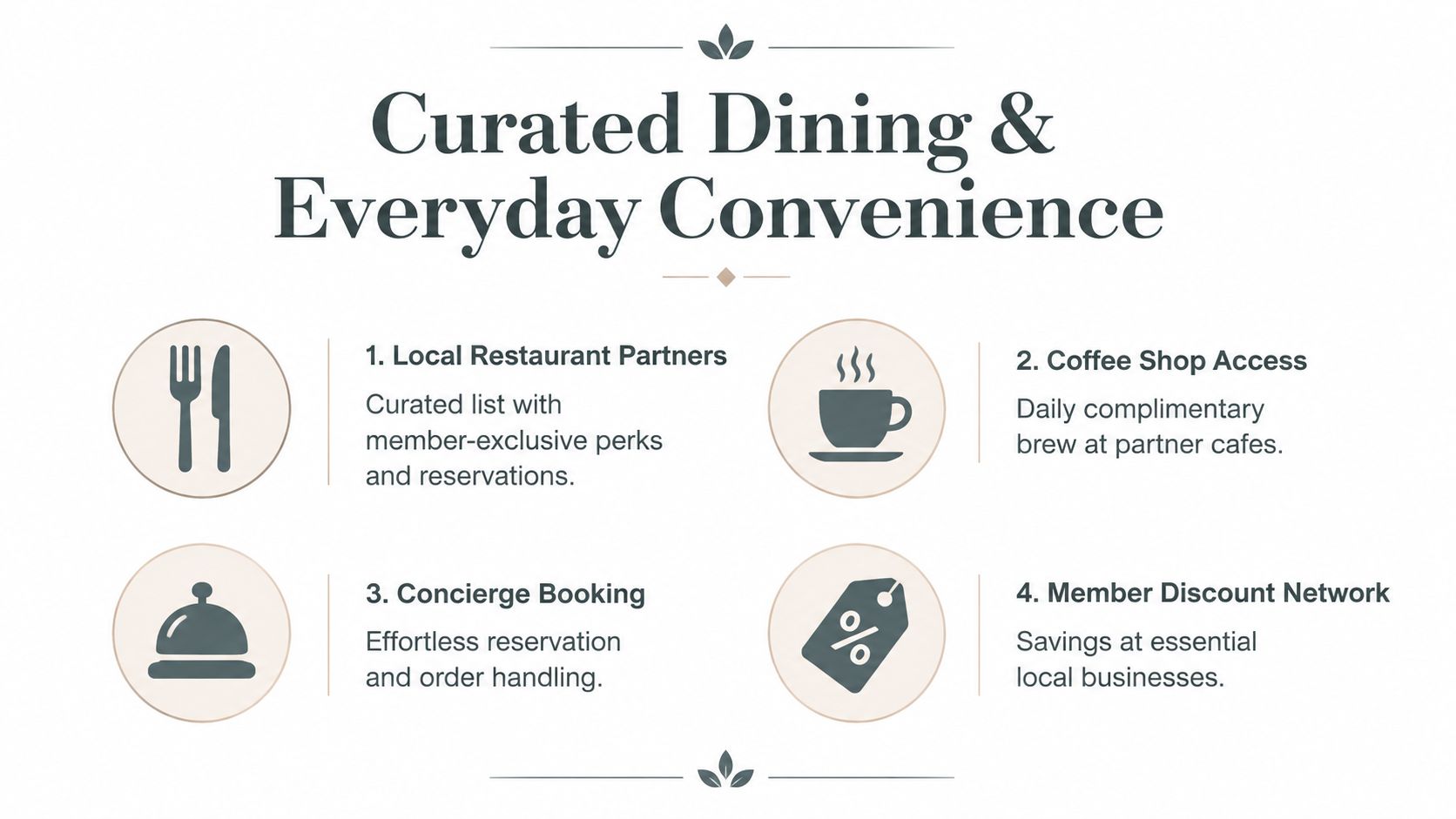
A member's workday rarely falls apart because of one major problem. More often, it gets fragmented by lunch orders, coffee runs, package pickups, and short trips that require leaving the building. Freeform House addresses those interruptions through curated local partnerships and practical services.
A member might begin with coffee from a partner shop, order lunch from a restaurant partner, and keep working while the meal arrives at their space at no extra delivery cost. Later, an Amazon Hub Locker can provide a secure package pickup point, while the rentable golf cart fleet can make short trips around the Ten District easier to manage.
Convenience is a chain of small decisions
Consider a team preparing for an afternoon presentation. Someone needs coffee, someone else is waiting for a delivery, and the presenter has to make a quick trip across the district. In a conventional office, each task creates a separate interruption. Within a membership setting, those tasks can fit into the same working rhythm.
The concierge assistance service adds another layer by helping members handle reservations and orders more smoothly. That matters for a host arranging dinner, an executive coordinating a client visit, or an entrepreneur trying to keep a meeting on schedule.
These services don't replace the main workspace benefits. They make those benefits easier to use. A quiet room is more valuable when the member doesn't have to leave it for every meal or delivery. A local event is easier to host when transportation and reservations require less coordination.
Convenience becomes valuable when it protects attention. The benefit isn't only the coffee, package, or golf cart. It's the preserved focus around those services.
Events, Hosting, and Networking
A meeting room becomes more powerful when it can lead to an event. A studio becomes more useful when the people featured in its content can gather nearby. Dining partnerships become more relevant when a host can arrange food for guests without managing every outside vendor separately.
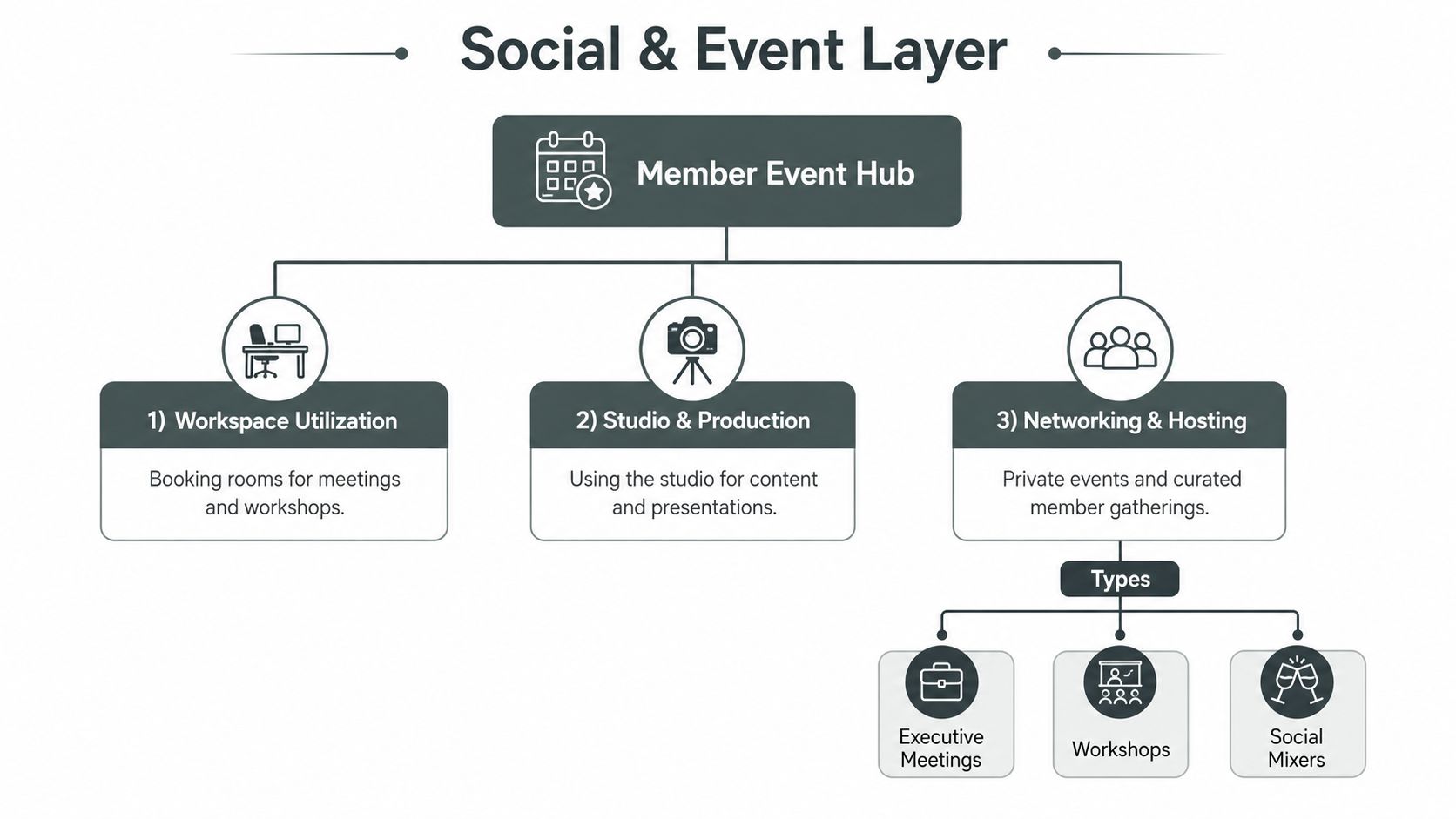
Freeform House brings those functions into one social and event layer. Members can use the rooms and studio for executive meetings, workshops, private dinners, intimate weddings, and community gatherings. The setting also creates opportunities for local professionals to meet naturally, without every interaction requiring a formal networking event.
Hosting without starting from zero
A founder planning a product launch might begin in a signature room for a team briefing, use the studio to capture launch content, and then welcome clients and partners for an evening reception. The same person can coordinate dining, use the building's setting as the backdrop, and continue conversations with other members before and after the event.
That sequence creates more than convenience. It gives guests a coherent experience. They see the work, the people, and the community in one place. For the member, the event doesn't sit apart from daily club life. It grows from the same rooms and relationships used for ordinary work.
Executive meetings and workshops benefit from structure. Private dinners and social mixers benefit from atmosphere. Community gatherings benefit from the chance to introduce people who might otherwise remain separate.
The member-only events information is useful for prospects who want to understand how access can support both business and social hosting. The central value is not permission to rent a room. It's the ability to build an occasion around an existing environment, service model, and professional community.
Networking works best when people have a reason to return. Shared workspaces, production sessions, meals, and events create repeated points of contact that feel more natural than exchanging introductions once.
Who the Membership Is Really Built For
Freeform House isn't equally useful to everyone. Its value rises when a member needs several kinds of access and wants them connected in one place.
The local entrepreneur
A Jenks entrepreneur may need a professional place for client meetings without maintaining a full private office. The strongest combination is a signature room, everyday dining support, and event access. That mix supports the workday before, during, and after the meeting.
The creative professional
A photographer, podcaster, or video producer needs more than a desk. The Rise loft studio and podcast booth matter most here, especially when the creator can also use workspace and meeting rooms for planning, reviews, and client presentations. The membership becomes a production base rather than an occasional rental.
The executive team
A hybrid leadership group may need a setting for concentrated planning away from ordinary office routines. The Executive Room can support private discussions, while the broader building gives the team options for meals, informal conversations, and a structured offsite experience.
The intimate event host
A host arranging a private dinner, small wedding, launch, or community gathering needs atmosphere and coordination. Rooms, creative resources, dining partnerships, and local conveniences work together to reduce the number of outside arrangements.
Personalization determines whether these combinations feel relevant. In a 2025 member-experience report, 84% of members said personalization is important, while 81% believed their association already provided it, revealing a perception mismatch. That gap helps explain why a membership should be evaluated by fit, not by the total number of available perks.
Self-select honestly: If you only need an occasional desk, a simple workspace may be enough. If your work moves between meetings, content, hosting, and community, layered access has a stronger case.
Next Steps and Common Questions
Start with a practical review rather than an impulse decision. Think about the situations you expect to bring into the club, then ask how often those situations occur and which combination of benefits would support them.
A simple evaluation checklist
Book a tour: Walk through the rooms, studio, booth, shared areas, and convenience services.
Review membership tiers: Confirm what access is included, what requires separate booking, and how guests are handled.
Discuss your use case: Explain whether you're planning meetings, production sessions, an offsite, or private events.
Check availability: If you have a specific event or recording date in mind, ask about room and studio scheduling early.
Calculate practical value: Consider time saved, professional presentation, production access, and hosting flexibility together.
Common questions
How do the food and coffee partnerships work?Members can access curated local restaurant and coffee shop partnerships, with meals and beverages delivered to their space at no extra delivery cost. Ask the club about participating partners, ordering procedures, and available service windows.
Are the podcast booth and studio included?The club provides access to The Rise loft studio and an in-house podcast booth. Prospective members should confirm the booking process, included equipment, usage policies, and whether a particular production requires an additional rental.
What kinds of events can members host?The spaces support executive meetings, workshops, private dinners, intimate weddings, community gatherings, and small receptions. The right room depends on guest needs, event format, privacy, and atmosphere.
How do the Amazon Hub Lockers and golf carts work?The Amazon Hub Lockers provide secure, self-serve package pickup, while the rentable golf cart fleet supports short trips around the Ten District. Ask during a tour how members reserve and access each service.
Freeform House is most compelling when you view the membership as a value stack. Workspace supports focus, creative rooms support production, local services protect time, and events create reasons to gather. Together, those layers can serve a working life that changes from one hour to the next.
Freeform House brings together signature work rooms, The Rise loft studio, podcast production, curated dining, package access, local transportation, and private event hosting in downtown Jenks. Visit Freeform House to tour the space, review membership options, and discuss how its exclusive member benefits could fit your work and community plans.
Comments