10 Essential Small Business Growth Strategies for Local Entrepreneurs in 2026

For entrepreneurs in communities like Jenks and Tulsa, growth is not just about scaling; it's about building lasting local impact. The difference between stagnation and breakthrough success often lies in the specific small business growth strategies you choose to deploy. Moving past generic advice, this guide provides a comprehensive roundup of 10 powerful, actionable frameworks tailored for the modern local business owner.
We are diving deep into practical methods that deliver tangible results. You will learn how to forge impactful strategic partnerships, create premium membership tiers to segment your audience, and transform your space into a hub for high-value corporate events. Each strategy is broken down into a clear, step-by-step implementation plan designed for immediate application.
This is not a theoretical exercise. We will show you how to leverage a dynamic local asset, such as the new Freeform House in Jenks' 10 District, to act as a powerful catalyst for these initiatives. As a premier, membership-based club envisioned to be comparable to the renowned SoHo House, it offers more than just a social club. Members can take advantage of co-working spaces and a dynamic community hub designed for collaboration and connection. It's a central gathering spot aimed at fostering a creative and cooperative spirit within our local community.
This article is your roadmap to sustainable expansion. It’s designed to equip you with fresh perspectives and the specific tools needed to identify and implement the most effective growth levers for your business. Prepare to find your next breakthrough idea and unlock your next level of success.
1. Strategic Partnership Development
One of the most effective small business growth strategies involves creating alliances with complementary, non-competing businesses. This approach, known as strategic partnership development, allows you to tap into new customer bases, enhance your service offerings, and create a unique value proposition that sets you apart from the competition. By joining forces, businesses can share resources, cross-promote, and build a supportive ecosystem that benefits everyone involved.
This strategy works because it leverages the trust and loyalty another business has already built with its audience. Instead of starting from scratch, you gain a warm introduction to potential customers who are likely to be interested in what you offer. For a premier hub like Freeform House, this means partnering with local Jenks restaurants to provide members with exclusive catering options or collaborating with a high-end coffee shop to create a signature co-branded beverage.
How to Implement Strategic Partnerships
Implementing this strategy requires a clear, methodical approach to ensure mutual benefit and long-term success.
Identify Potential Partners: Look for local businesses whose target audience overlaps with yours but who are not direct competitors. For example, a coworking space could partner with accounting firms, marketing agencies, or corporate wellness providers.
Formalize the Agreement: Never rely on a handshake. Draft a clear partnership agreement that outlines responsibilities, revenue sharing, marketing commitments, and service standards for both parties.
Co-Create Exclusive Offers: Develop unique, co-branded packages or services available only through the partnership. This creates a compelling reason for customers to engage and differentiates your offering.
Launch and Promote Together: Create a joint marketing campaign to announce the partnership. Use social media, email newsletters, and in-person events at a venue like Freeform House to generate buzz and excitement.
2. Membership Tiering and Premium Segmentation
A powerful small business growth strategy for service-based businesses is creating a tiered membership model. This approach involves offering multiple membership levels with distinct benefits, pricing, and access privileges. By segmenting your offerings, you can effectively capture different customer segments, from solo entrepreneurs on a budget to large corporate teams needing premium amenities, thereby maximizing revenue and customer lifetime value.
This strategy works because it aligns your value proposition with the specific needs and budgets of diverse customer profiles. Instead of a one-size-fits-all model, you create a clear path for customers to engage with your brand at a level that makes sense for them. For a premier hub like Freeform House, this means offering tiers like a basic hot desk membership, a dedicated desk with mail services, and an all-access executive membership that includes private office use and priority booking for the podcast studio.
How to Implement Membership Tiering
Rolling out a successful tiered model requires careful planning to ensure each level offers clear and compelling value.
Define Customer Segments: Conduct surveys and analyze customer data to understand what different groups value most. A freelancer may prioritize flexible access, while a corporate team needs dedicated meeting spaces and premium tech.
Structure Your Tiers: Create distinct levels with clearly differentiated benefits. For example, a "Community" tier might offer event access, while a "Professional" tier includes coworking hours, and a "Premier" tier grants exclusive use of high-end amenities.
Price Strategically: Set price points that reflect the value of each tier. The goal is to make upgrading to the next level an attractive and logical step. Ensure the price jump is justified by the added benefits.
Create a Clear Upgrade Path: Actively encourage members to move to higher tiers as their needs evolve. Offer incentives, such as a one-time discount or a trial period, for upgrading their membership.
3. Corporate Event and Offsite Hosting
Another powerful small business growth strategy is to position your unique space as a premium destination for corporate meetings, team offsites, workshops, and private events. This approach leverages your facility's distinct ambiance and integrated amenities to attract high-value corporate clients. Many businesses are actively seeking alternatives to sterile hotel conference centers, creating a significant market for memorable, inspiring venues.

This strategy works because companies understand that the right environment can foster creativity, boost morale, and improve productivity during important offsites. A venue like Freeform House, with its restored 1920s historical charm, offers an experience that standard venues cannot match. By hosting corporate clients, you not only generate significant revenue from a single booking but also introduce dozens of local professionals to your brand, creating future members and advocates.
How to Implement Corporate Event Hosting
Successfully attracting corporate clients requires a professional, service-oriented approach that caters to their specific needs for efficiency and quality.
Develop Tiered Corporate Packages: Create clear, all-inclusive packages based on group size, duration, and amenities. Offer options for catering, A/V equipment, and breakout rooms to simplify the booking process for busy event planners.
Build a Professional Portfolio: Showcase past successful events with high-quality photos, client testimonials, and detailed case studies. A strong portfolio demonstrates your capability and helps potential clients envision their event in your space.
Market Your Unique Value: Emphasize what sets your venue apart. For Freeform House, this means highlighting the historic ambiance, exclusive access, and white-glove concierge service that transforms a standard meeting into a memorable experience.
Build Industry Relationships: Network with corporate event planners, executive assistants, and HR managers who are often responsible for booking offsites. Offer them a private tour and a small incentive for their first booking. For more detailed guidance, use this corporate event planning checklist for 2025 to refine your offerings.
4. Content Marketing and Thought Leadership
One of the most powerful small business growth strategies is to stop selling and start helping. This is the core of content marketing and thought leadership: consistently creating valuable, relevant content that addresses your audience's pain points and positions your brand as a trusted authority. Instead of direct advertising, you build a loyal community by providing expertise, which naturally attracts and nurtures potential customers.
This strategy is effective because it builds trust and credibility over time. When you provide answers and insights without asking for anything in return, you become the go-to resource in your field. For a hub like Freeform House, this means not just offering a space but becoming the center of entrepreneurial conversation in Jenks. By producing content that showcases member success stories or local business trends, the brand establishes itself as a pillar of the community, attracting members who want to be part of that ecosystem.
How to Implement Content Marketing and Thought Leadership
A successful content strategy requires a consistent, audience-focused approach to create a meaningful impact.
Identify Your Niche Expertise: Determine the specific topics where your business can provide unique value. What do your customers ask about most often? What problems can you solve better than anyone else? This will be the foundation of your content.
Leverage High-Quality Production: Use professional-grade tools to make your content stand out. For instance, creating a branded podcast or video series becomes far more accessible when using a dedicated space like the podcast studio at Freeform House.
Showcase Community and Member Success: Your best content often comes from your customers. Create member spotlight blogs, video testimonials, or interview them on your podcast. This provides authentic social proof and strengthens your community bonds.
Distribute and Repurpose Content: Create a core piece of content, like a webinar or in-depth blog post, and repurpose it into smaller assets. Turn key insights into social media graphics, video clips, or email newsletter snippets to maximize your reach and impact.
5. Referral and Ambassador Programs
One of the most powerful and cost-effective small business growth strategies is to transform your most satisfied customers into an active marketing force. By implementing incentivized referral and ambassador programs, you can systematically harness the power of word-of-mouth, which is especially potent in close-knit communities like Jenks and Tulsa. This strategy converts loyal clients into advocates who actively recruit new business on your behalf.
This approach is highly effective because it leverages trust. A recommendation from a friend or colleague carries far more weight than a traditional advertisement. For a community-focused hub like Freeform House, this means a member’s genuine praise about the productive atmosphere or valuable connections made is the most credible endorsement possible. It turns your existing membership base into a trusted, authentic, and highly motivated sales team.
How to Implement Referral and Ambassador Programs
A successful program is built on simplicity, attractive rewards, and consistent promotion, ensuring it’s both easy to use and genuinely valuable for participants.
Make Referrals Effortless: The process must be seamless. Provide members with unique referral codes or personalized links during onboarding. This removes any friction and makes it easy for them to share and for you to track.
Offer Compelling Incentives: Your rewards must motivate action. Consider offering tangible benefits like membership credits, free passes to exclusive events held at Freeform House, or gift cards to local Jenks partner businesses.
Create Tiered Rewards and Recognition: Encourage multiple referrals by implementing a tiered system where rewards increase with the number of successful sign-ups. You can also create an exclusive "ambassador" tier for your top advocates, offering them special perks and early access to new amenities.
Track and Promote Your Program: Consistently remind members about the program through email, in-app notifications, and personal interactions. Host referral appreciation events to recognize and celebrate your most active ambassadors, reinforcing the value you place on their contributions.
6. Niche Market Segmentation and Specialization
Instead of trying to be everything to everyone, one of the most powerful small business growth strategies is to identify and dominate a specific niche market. This approach, known as niche market segmentation, involves tailoring your products, services, and marketing to the unique needs of a well-defined audience. By specializing, your business becomes the go-to solution for that segment, fostering deep customer loyalty and commanding premium positioning.
This strategy is effective because it allows you to concentrate your resources where they will have the most impact. You can craft highly relevant messaging that speaks directly to your target audience's pain points, making your marketing more efficient and effective. For a premium venue like Freeform House, this means moving beyond a generic "coworking space" label and specializing as the premier hub for Jenks' creative professionals, podcasters, and executive teams seeking an elevated offsite experience.
How to Implement Niche Specialization
Successfully carving out a niche requires deep audience understanding and a commitment to serving that segment exceptionally well.
Identify High-Value Niches: Research the local Tulsa and Jenks business ecosystem to find underserved or high-value professional groups. Survey your existing customers to understand their primary industries and biggest challenges.
Develop Niche-Specific Offerings: Create tailored packages or amenities that solve a specific problem for your target segment. This could be a "Podcast Production Suite" membership at Freeform House or a "Leadership Offsite" package for corporate teams.
Speak Their Language: Use niche-specific language, visuals, and marketing channels to connect with your audience. Create dedicated landing pages on your website for each major segment, showcasing how you meet their unique needs.
Foster a Niche Community: Host targeted events that bring your niche audience together, such as a "Podcast Producer Meetup" or a "Creative Directors Roundtable." This solidifies your position as the central hub for that community and encourages valuable peer-to-peer connections.
7. Technology Integration and Digital Experience
One of the most powerful small business growth strategies is leveraging technology to streamline operations and elevate the customer journey. By integrating digital tools like booking systems, member apps, and community platforms, you can create a seamless, modern experience that sets your business apart. This approach not only improves efficiency but also provides valuable data to drive smarter decisions and foster deeper customer engagement.
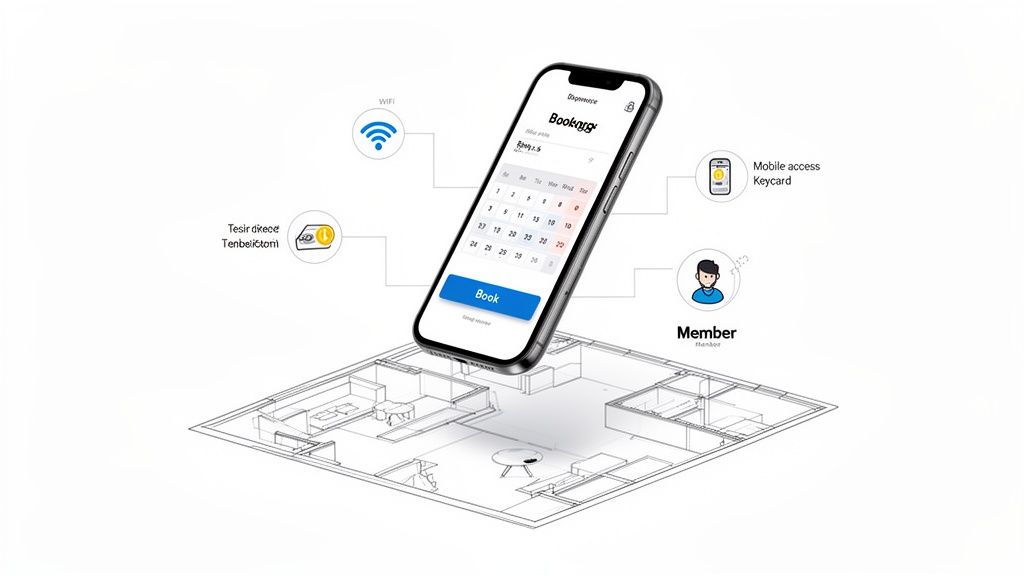
This strategy works by meeting modern customer expectations for convenience and connectivity. For a premier hub like Freeform House, this means implementing a comprehensive app where members can book meeting rooms, access a digital directory to network with other local professionals, and even use their phone for keyless entry. This tech-forward approach removes friction from the member experience, making it effortless to engage with the space and its community.
How to Implement Technology Integration
Successfully integrating technology requires a thoughtful approach focused on enhancing the user experience rather than just adding features.
Select a Core Management Platform: Start with a robust platform like Cobot or Desktime to manage bookings, billing, and member data from a central dashboard. This forms the backbone of your digital operations.
Develop a Unified Member App: Create a branded mobile app that serves as the primary touchpoint for your customers. It should integrate key functions like booking conference rooms, event registration, support requests, and community forums.
Enable Seamless Access and Connectivity: Implement modern conveniences like app-based keyless entry and high-speed, reliable Wi-Fi. This ensures a secure and hassle-free experience from the moment a member arrives.
Analyze Usage Data for Optimization: Use the analytics from your platforms to understand which spaces are most popular and at what times. Use this data to optimize layouts, adjust pricing, and plan resources more effectively at your Freeform House location.
8. Strategic Location Expansion and Franchising
When a business model proves highly successful in one location, one of the most powerful small business growth strategies is to replicate that success elsewhere. Strategic location expansion involves opening new company-owned branches in different markets, while franchising allows other entrepreneurs to license your brand, business model, and operating systems to open their own locations. This approach dramatically scales your market reach and revenue streams by leveraging a proven formula.
This strategy works by capitalizing on a well-defined and successful concept. For a business like Freeform House, a thriving hub in Jenks could be replicated in other Tulsa metro areas like Broken Arrow or even franchised to entrepreneurs in similar cities. This method leverages established brand equity and operational efficiencies to accelerate growth far beyond what a single location could achieve, transforming a local gem into a regional or national presence.
How to Implement Expansion and Franchising
Scaling your physical footprint requires meticulous planning and a deep understanding of what makes your current operation successful.
Validate the Model: Before expanding, ensure your flagship location is consistently profitable and operates efficiently. Create a comprehensive playbook that documents every process, from member onboarding to event management.
Conduct Market Analysis: Thoroughly research potential new locations. Analyze demographics, local competition, and commercial real estate opportunities to identify areas with a high probability of success.
Develop a Scalable System: Standardize everything from your brand guidelines and interior design to your technology stack. A uniform experience is crucial for maintaining brand integrity across multiple locations.
Build a Strong Support Structure: Whether you open a company-owned store or recruit a franchisee, you need a centralized support system. This includes robust training programs, marketing assistance, and ongoing operational guidance to ensure every location meets your high standards.
9. Community Events and Programming
One of the most powerful small business growth strategies is to transform your physical location into a vibrant community hub through curated events and programming. This approach goes beyond simply selling a product or service; it builds an engaged audience, fosters loyalty, and creates an environment where customers become brand advocates. By hosting workshops, networking sessions, and unique social gatherings, a business can become a central pillar of the local community.
This strategy works by generating consistent foot traffic and creating authentic connections that a digital ad campaign simply cannot replicate. For a premier membership club like Freeform House, a robust calendar of events justifies membership fees, attracts new prospects, and solidifies its reputation as the go-to destination in Jenks for professional and creative connection. It turns a beautiful space into a dynamic, must-visit location.
How to Implement Community Events
Building a successful event program requires a strategic, member-focused approach that consistently delivers value and excitement.
Survey Your Audience: Before planning, ask your members or customers what they want to see. Use simple surveys to gauge interest in specific topics, formats (workshops vs. social mixers), and preferred times.
Create a Diverse Calendar: Plan a monthly or quarterly calendar that appeals to different segments of your audience. Mix professional development workshops with social networking events and unique cultural programming to keep things fresh.
Leverage In-House Talent: Tap into the expertise within your own community. Invite members or local business owners to host workshops or speak at events, which highlights their skills and provides authentic content for attendees.
Launch and Promote Actively: Use email newsletters, social media, and in-venue signage to promote your calendar. Partner with local media or influencers to broaden your reach for signature events hosted at a premium venue like Freeform House.
Track and Measure Engagement: Use RSVP and attendance data to understand which events are most popular. This information is crucial for refining your programming and demonstrating the ROI of your community-building efforts.
10. Strategic Pricing, Revenue Optimization, and Brand Marketing
One of the most potent small business growth strategies is the integration of intelligent pricing with strong brand marketing. This dual-pronged approach involves setting prices based on data and perceived value, not just cost, while simultaneously building a premium brand that justifies those prices. By optimizing revenue streams and communicating a compelling brand story, you can maximize profitability and cultivate long-term customer loyalty.
This strategy is highly effective because it moves beyond a race to the bottom on price. Instead, it focuses on building brand equity that commands a premium. For a membership club like Freeform House, this means positioning itself not just as a coworking space but as an exclusive hub for Jenks' top professionals. This brand positioning allows for value-based pricing tiers that reflect the unique ambiance, community, and amenities offered, similar to how brands like Soho House create an aspirational lifestyle around their membership.
How to Implement Strategic Pricing and Brand Marketing
A successful implementation requires a disciplined, data-informed approach to both how you price your offerings and how you present your brand to the market.
Develop a Tiered, Value-Based Pricing Model: Create distinct membership or service tiers with clearly differentiated value. Conduct surveys and A/B test price points to understand what your target audience is willing to pay for premium features versus essential services.
Bundle Services and Offer Strategic Discounts: Create high-margin bundles that combine popular services, such as a corporate package including dedicated desks, meeting room credits, and event hosting. Use annual membership discounts (e.g., 10-15%) to secure upfront cash flow and improve retention.
Build a Cohesive and Premium Brand Identity: Invest in professional brand assets, including high-quality photography and videography, that showcase your space and the member experience. Develop a clear brand story that resonates with your target audience, such as Freeform House’s mission to foster connection and creativity on Main Street.
Execute Targeted Marketing Campaigns: Use your strong brand identity to launch focused campaigns. Create landing pages for different customer segments (e.g., corporate teams, creative freelancers), run local SEO targeting keywords like "premium Jenks meeting space," and use visual platforms like Instagram to highlight your unique design and community atmosphere.
10-Strategy Small Business Growth Comparison
Strategy | Complexity (🔄) | Resources & Speed (⚡) | Expected Outcomes (⭐📊) | Ideal Use Cases (💡) |
|---|---|---|---|---|
Strategic Partnership Development | Medium–High 🔄 — coordination, contracts, quality alignment | Low capital, moderate staff/time ⚡ — co-marketing & coordination | High ⭐📊 — expanded services, lower CAC, new revenue streams | Local partnerships (restaurants, service providers), bundled offerings |
Membership Tiering and Premium Segmentation | Medium 🔄 — access controls, communication, billing systems | Low–Medium ⚡ — pricing design + automated billing | High ⭐📊 — higher ARPM, upsells, improved retention | Capture diverse members from freelancers to executive teams |
Corporate Event and Offsite Hosting | High 🔄 — event ops, scheduling, member access management | Medium–High ⚡ — AV, catering, event staff | High ⭐📊 — high-margin bookings, corporate relationships, off-peak utilization | Team offsites, workshops, private events, corporate hospitality |
Content Marketing and Thought Leadership | Medium 🔄 — editorial consistency and production workflows | Medium ⚡ — studio use, production team, ongoing content cadence | Medium–High ⭐📊 — SEO, inbound leads, brand authority over time | Build long-term inbound pipeline; showcase member expertise |
Referral and Ambassador Programs | Low–Medium 🔄 — tracking, attribution, reward rules | Low ⚡ — incentive costs and simple tracking tools | High ⭐📊 — low CAC, high-quality referrals, improved retention | Community-driven growth in tight local networks |
Niche Market Segmentation and Specialization | Medium–High 🔄 — research, tailored programming, positioning | Low–Medium ⚡ — niche amenities and targeted marketing | High ⭐📊 — premium pricing, strong community cohesion | Podcasters, creatives, executives — become go-to solution |
Technology Integration and Digital Experience | High 🔄 — development, integrations, security | High ⚡ — significant upfront + ongoing maintenance | High ⭐📊 — better UX, data-driven ops, scalability | Scale operations, hybrid/higher-touch member experiences |
Strategic Location Expansion and Franchising | Very High 🔄 — systemization, franchise/legal complexity | Very High ⚡ — real estate, capital, training infrastructure | High ⭐📊 — revenue scale, regional brand dominance (with risks) | Proven model ready to replicate across region/markets |
Community Events and Programming | Medium 🔄 — curation, scheduling, attendance management | Medium ⚡ — events staff, hospitality, marketing | High ⭐📊 — increased engagement, retention, trial conversions | Regular mixers, workshops, speaker series to drive community |
Strategic Pricing, Revenue Optimization & Brand Marketing | High 🔄 — analytics, testing, cross-channel coordination | Medium–High ⚡ — marketing spend, pricing tech, creative assets | High ⭐📊 — improved revenue per member and brand equity | Mature operations seeking profitability and premium positioning |
Your Blueprint for Growth Starts Here
Navigating the path to sustainable business growth can often feel like assembling a complex puzzle without the final picture. The ten comprehensive small business growth strategies detailed in this article, from strategic partnership development to targeted brand marketing, are the individual pieces of that puzzle. Each one represents a powerful lever you can pull to drive momentum, expand your reach, and deepen your connection with the local Jenks and Tulsa communities. We've moved beyond generic advice to provide a tactical roadmap, complete with implementation steps, key performance indicators, and real-world scenarios.
The journey from a promising startup to a community cornerstone is not a solitary one. It's built on connection, collaboration, and a relentless commitment to excellence. The strategies we've explored, such as forming powerful local alliances, hosting impactful corporate offsites, and building a loyal following through community events, all share a common thread: they thrive in an environment designed for interaction and innovation.
Synthesizing Strategy into Action
The true differentiator for your business won't be just knowing these strategies; it will be in the execution. It's about how you adapt these concepts to your unique brand identity and the specific needs of your customers.
Consider these core takeaways as you plan your next steps:
Integration is Key: The most powerful results emerge when these strategies are not implemented in isolation. A strong content marketing plan amplifies your referral program. A sophisticated membership model provides a perfect audience for exclusive community events. Look for opportunities where one strategy can directly support another, creating a flywheel effect that accelerates your growth.
Community is Your Catalyst: Whether you're a creative professional, a local entrepreneur, or a corporate team, your success is intrinsically linked to the strength of your local network. Strategies like partnership development and community programming are not just "nice-to-haves"; they are essential engines for generating leads, building brand loyalty, and establishing yourself as a leader in the Tulsa area.
The Right Environment Matters: Your physical surroundings can either hinder or accelerate your strategic execution. Attempting to build a powerful brand from a makeshift office or a noisy coffee shop creates unnecessary friction. To forge meaningful partnerships, produce high-quality content, and host events that leave a lasting impression, you need a professional, inspiring, and well-equipped space that reflects the quality of your business. This is where a hub like Freeform House becomes a strategic asset, not just an overhead expense.
Your Immediate Next Steps
Feeling overwhelmed by the possibilities is normal. The goal is not to implement all ten strategies at once. Instead, focus on a disciplined, phased approach.
Conduct a Self-Audit: Review the ten strategies and identify the one or two that align most closely with your immediate business goals and available resources. Are you struggling with customer acquisition? Start with referral programs. Do you need to elevate your brand's authority? Focus on content marketing and thought leadership.
Define Your Metrics: For the chosen strategies, refer back to the KPIs we outlined. Establish your baseline and set realistic, measurable goals for the next 90 days. What does success look like, and how will you track it?
Find Your Hub: Identify the physical and communal resources you need to execute your plan. If your strategy involves networking, content creation, or hosting clients, your environment is a critical part of the equation.
Ultimately, mastering these small business growth strategies is about more than just increasing revenue. It's about building a resilient, adaptable, and deeply connected business that becomes an indispensable part of the local economic fabric. It's about creating a legacy. The blueprint is in your hands; now is the time to start building.
Ready to put these strategies into action in an environment built for success? Discover how the exclusive co-working spaces, event venues, and production studios at Freeform House can provide the professional foundation you need to connect, create, and grow. Schedule a tour today to find your place in Jenks' premier community for ambitious entrepreneurs.
Comments