How to Start Podcasting: A Practical Launch Guide

You've got a podcast idea, a notes app full of episode topics, and possibly a microphone sitting unopened in its box. You can already imagine the first recording going well. The harder question is whether you can still produce episode twenty when work gets busy, a guest cancels, or your home office sounds like a refrigerator repair shop.
That's the practical test behind how to start podcasting. Podcasting is now a mature media channel, with industry estimates placing global listeners at roughly 584.1 million in 2026, projected to reach about 619 million by the end of the year, alongside as many as 4.58 million podcasts worldwide (Podcast Industry Statistics). The opportunity is real, but so is the competition. Your advantage won't come from buying the most impressive microphone. It'll come from building a show you can make repeatedly, in a space and workflow that remove excuses.
Why Most First Podcasts Quietly Disappear
A common first move looks sensible. A motivated creator buys a $300 microphone, records two energetic episodes, spends too long polishing the intro, and then discovers that every new episode requires rearranging the house, negotiating for quiet, and relearning the recording software. By the third month, the podcast has stopped without a formal decision to end it.
The problem usually isn't a lack of enthusiasm. It's the gap between enthusiasm and production design. Industry guidance notes that many new podcasts fail to continue beyond the first 10 to 20 episodes (podcast benchmarks and best practices). That pattern makes the first ten episodes a testing runway, not a final judgment on your idea.
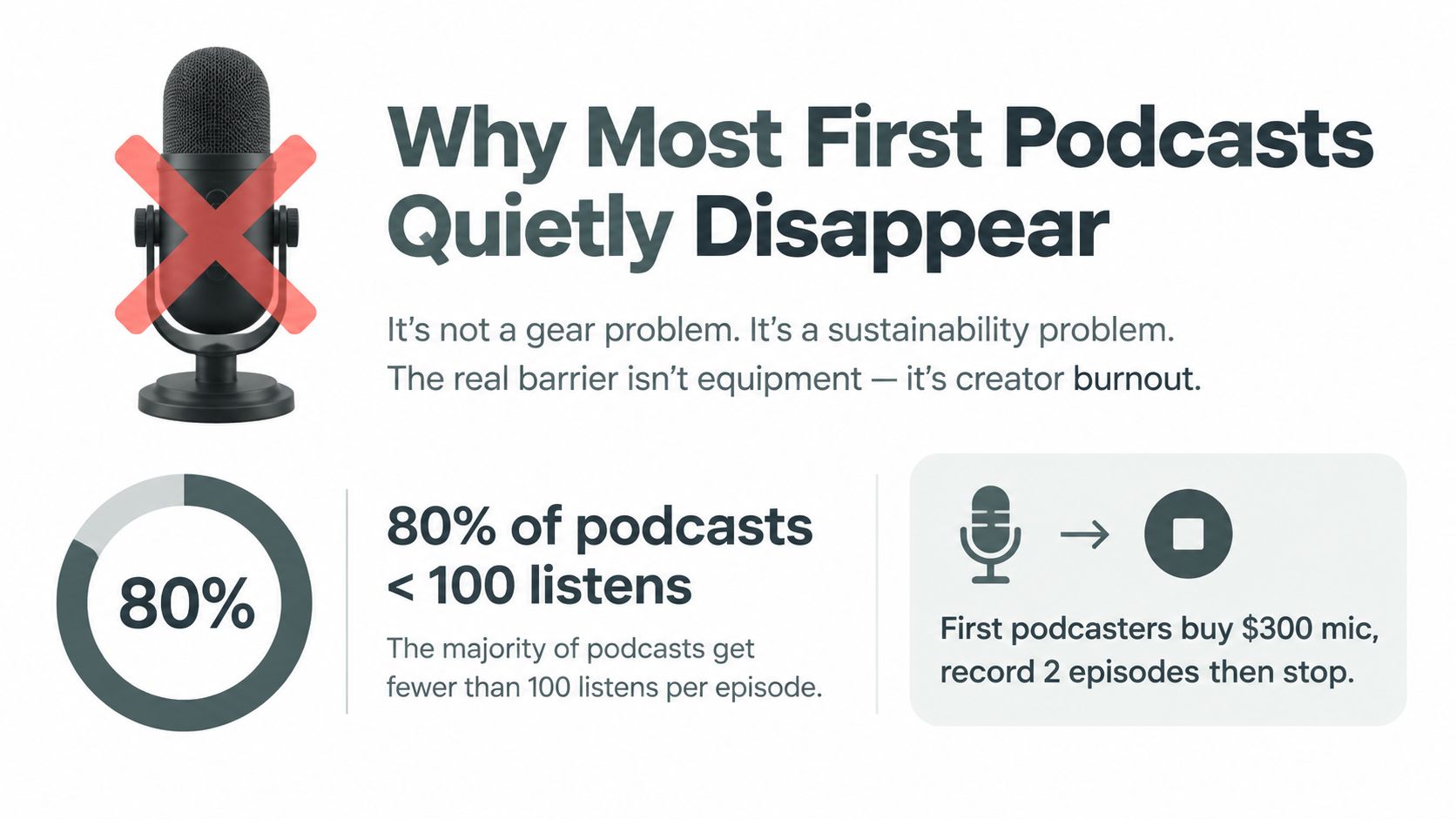
Three failure points appear repeatedly:
Schedule drift: Recording gets pushed because the session has no protected place on the calendar.
An unclear listener: The host keeps changing the topic, tone, or promise because the show wasn't defined tightly enough.
Setup friction: A makeshift room, inconsistent microphone position, background noise, and complicated file handling make every episode feel like a new technical project.
Each problem has a practical counter. A fixed weekly or bi-weekly release rhythm creates a production habit. A clear audience and repeatable format make planning easier. A treated, bookable recording booth eliminates the home-studio excuse by putting the room, microphone, lighting, and recording setup in one place.
Production rule: A sustainable 20 to 30 episode runway is more valuable than an equipment upgrade you can't use consistently.
Podcasting has moved well beyond its early niche phase. Another 2026 market summary estimated 672 million monthly listeners worldwide, compared with 546 million in 2024, while total podcasts or feeds were estimated between 4.4 million and 4.72 million, depending on the tracking method (2026 podcast statistics). That scale creates room for focused shows, but it also means a vague concept and irregular publishing schedule will disappear quickly.
Before you buy anything else, answer one question: can you protect the time, location, and editorial process needed to make the next twenty episodes? If the answer is uncertain, solve that before chasing a better microphone.
Picking a Niche and Format That You Can Sustain
Start by answering one question: can you produce twenty episodes without treating each one as a separate project?
Write a one-sentence promise:
This show helps [specific listener] understand or do [specific thing] through [your distinctive approach].
A broad idea such as “business conversations” gives you little editorial direction. A tighter version could be, “A weekly show for Jenks and Tulsa service-business owners who want practical conversations about hiring, local growth, and resilient operations.” It identifies the listener, subject, and a natural source of guests.
Test the idea before recording
Write at least 30 distinct episode angles before committing. Group them into recurring content buckets:
Operator lessons: What worked, what failed, and what changed.
Local intelligence: People, projects, and businesses shaping the community.
Practical playbooks: A focused process listeners can apply.
Guest perspective: Experience you do not have.
If you can produce only a handful of ideas, the niche may be too narrow, too dependent on one guest, or tied to a temporary trend. If you can produce dozens, remove weaker ideas and identify themes you can revisit without repeating yourself.
Use the format your schedule can support, not the format that sounds most ambitious. A solo show gives you scheduling control, but it requires strong outlines and a host who can carry the episode. A co-hosted show feels more conversational, but both people need compatible calendars and clear handoff rules. An interview show spreads the energy across guests, while research, outreach, booking, preparation, and rescheduling add work beyond the recording session.
Episode length should fit the subject and your workflow. For a new show, a 20 to 35 minute target often leaves enough room for a useful idea without turning editing into a week-long project. The number is not a law. A concise educational episode can be shorter, while a substantial interview can run longer when every segment earns its place.
Run a sustainability check
Ask yourself:
Can I explain the show without listing several unrelated topics?
Can I name the listener more precisely than “anyone interested”?
Can I outline ten episodes without inviting a guest?
Can I record the format when my preferred co-host or guest is unavailable?
Can I prepare, record, edit, publish, and promote an episode within my actual schedule?
If any answer is uncomfortable, fix the concept before buying equipment or polishing a trailer. A clear niche reduces decisions, shortens preparation, and gives listeners a reason to return. It also makes a repeatable recording workflow possible, whether that means a consistent home setup or an in-house booth that removes the room problem from every episode. The goal is a show you can sustain through its first twenty to thirty episodes, not a technically impressive pilot you cannot reproduce.
Choosing Where to Record Without Buying a Studio
The recording room affects more than sound. It determines how quickly you can begin, how much editing you need, and whether you can repeat the process when life gets noisy.
A home setup can work if you have a quiet, furnished room and enough control over interruptions. An in-house booth works well for creators who want consistent sound without owning acoustic treatment. A rented studio can deliver a polished production environment, but it may introduce travel time, higher booking costs, or less flexibility.
Recording space options compared
Option | Monthly Cost | Sound Quality | Setup Friction |
|---|---|---|---|
Home room | Varies with existing equipment and treatment | Inconsistent in untreated rooms, stronger with soft furnishings and acoustic control | High if you must rebuild the setup for every session |
In-house booth | Based on booking or membership terms | Consistent when the booth is treated and equipment is maintained | Low, because the room and core setup are ready |
Rented studio | Based on studio rates and booking frequency | Typically controlled and production-ready | Medium, with travel, availability, and session planning to manage |
Hard walls, bare floors, windows, HVAC noise, and changing microphone positions create problems that software can't fully repair. Echo can make speech feel distant, background noise can force aggressive noise reduction, and inconsistent volume can make episodes sound as if they were recorded in different shows. The result is editing drag, not just an aesthetic flaw.
A reliable room often improves the workflow more than a premium microphone sitting in an untreated office.
An in-house booth is particularly useful when the creator has a demanding day job, shares a home, or records with guests. A coworking studio that offers a podcast booth with microphones, lighting, and recording support lets you book one reservation instead of assembling a temporary studio from separate pieces. Review podcast studio rental rates before comparing providers, because the hourly terms and included equipment can change the practical value of a booking.
Inspect before you commit
Visit or ask for a short demonstration. Check whether the booth has audible HVAC noise, whether guests can hear one another naturally, whether headphones and cables are ready, and whether the operator can provide separate audio tracks. Confirm the cancellation policy, booking access, file delivery process, lighting setup, and whether editing software is included or merely available on request.
The right choice is the one you can use repeatedly. If home recording is quiet and convenient, keep it simple. If every session starts with moving furniture and ends with repairing room echo, a booth can be a more rational investment than adding more gear.
A Simple Recording and Editing Workflow
Use the same opening routine every time. Consistency lets you focus on the conversation instead of wondering whether the recording started.
The 60-second pre-roll
Before anyone speaks:
Close unnecessary apps and browser tabs.
Silence phone and computer notifications.
Confirm the correct microphone input and headphones.
Hit record 10 seconds before the conversation begins.
Leave 5 seconds of silence at the end of the session.
Capture 30 seconds of room tone at the start.
The silence gives you a clean reference for edits and noise checks. Keep segment markers for the introduction, main discussion, transitions, sponsor or membership mentions, and closing call to action. In a co-hosted episode, decide who owns each handoff before recording. If someone makes a mistake, pause, repeat the sentence cleanly, and continue. Don't restart the entire conversation unless the mistake changes the meaning.
Name files by episode number and date, such as . Use separate folders for raw recordings, project files, exports, transcripts, and social clips. A clear file system matters once guests, revisions, and multiple episodes enter the workflow.
Technical targets
Record lossless 24-bit, 48 kHz WAV audio. Keep tracking peaks between -12 dBFS and -6 dBFS, use mono for a single-microphone conversation, and avoid recording so you need extreme gain later. Podcast production guidance also recommends mastering around -16 LUFS stereo with true peaks below approximately -1 dBTP (podcast broadcast production guide).
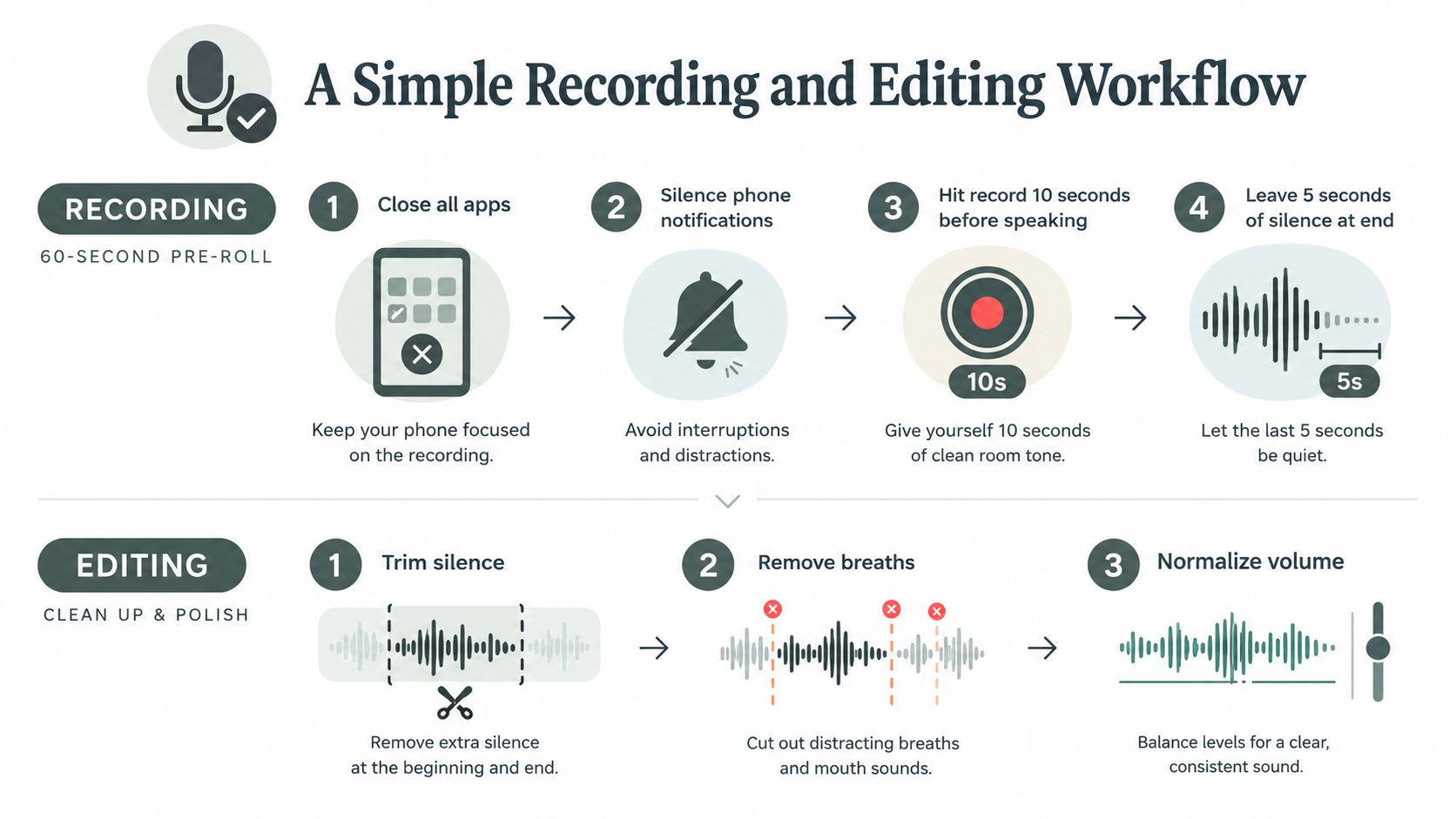
Edit in this order:
Import and organize the tracks.
Remove long pauses and silence below -40 dB where it improves pacing.
Cut distracting filler words, mouth clicks, repeated phrases, and obvious mistakes.
Apply gentle compression to reduce large volume differences.
Add a high-pass filter at 80 Hz to reduce low-frequency rumble.
Normalize the finished program to -16 LUFS.
Export an MP3 at 192 kbps.
Use restraint. Removing every breath can make a person sound unnatural, and excessive compression creates fatigue. The best edit preserves the host's personality while removing distractions that compete with the content.
For a visual demonstration of a repeatable production sequence, use this content production workflow.
A treated in-house booth reduces room-treatment variables. When the space is acoustically controlled, positioned away from obvious HVAC noise, and already configured for recording, your levels and editing decisions stay more consistent from episode to episode.
Hosting, RSS, and Getting on Apple and Spotify
Hosting, RSS, and directory submission form one pipeline. Your host stores the audio and creates the RSS feed. The feed carries your show metadata and episode information to directories such as Apple Podcasts and Spotify.
Choose the host for the next year
Compare more than the introductory price. Look at storage limits, bandwidth, episode limits, IAB-certified analytics, transcription options, and the pricing tier you'll need if downloads grow beyond 10,000 per month. Common categories include independent-friendly services such as Buzzsprout, Transistor, and Captivate; creator-stack options such as Spotify for Creators and YouTube; and enterprise platforms designed for larger teams.
Host | Starting Price | Free Tier | IAB Analytics | Best For |
|---|---|---|---|---|
Buzzsprout | Depends on current plan | Check current offer | Check current plan | Independent creators wanting a guided workflow |
Transistor | Depends on current plan | Check current offer | Check current plan | Multiple shows and team publishing |
Captivate | Depends on current plan | Check current offer | Check current plan | Marketing-focused creators |
Spotify for Creators | Depends on current offer | Check current offer | Check current offer | Creators already working in Spotify's ecosystem |
YouTube | Depends on current platform terms | Check current offer | Platform-specific | Video-first discovery and distribution |
Pricing and feature tiers change, so verify current terms before signing up. Treat the RSS feed as a long-term asset. Moving hosts later requires redirects and careful testing, and older links can break if the migration is mishandled.
Submit in the right order
Select the hosting platform.
Create the show and claim the RSS feed.
Validate the feed with Cast Feed Validator or Podcast Connect.
Prepare the artwork and metadata.
Submit the feed to Apple Podcasts and Spotify about two weeks before launch.
Confirm that the listing, category, cover art, and episode information display correctly.
Prepare a title under 60 characters, a description with primary keywords in the first two lines, clean square 3000 by 3000 cover art, the author name, category, and explicit-content flag. Keep the artwork readable at small sizes. Avoid clutter, tiny text, and generic microphone imagery that tells a listener nothing about the actual show.
Launch Week, Cadence, and Getting Found
A first-time show often fails before the creator runs out of ideas. The test is whether the workflow can support a 20 to 30 episode runway. Record 3 to 5 episodes before publishing, then choose a weekly or bi-weekly schedule. That buffer covers illness, travel, guest delays, and edits that take longer than expected, without breaking your promise to listeners.
Use the first ten episodes as production tests. Note which topics produce thoughtful responses, where listeners stop, which guests fit, and which tasks consume too much time. A fixed cadence protects the show from being rebuilt every week.
Cadence test: Choose the schedule you can defend during your busiest ordinary week, not the schedule that looks impressive on launch day.
Daily publishing usually requires a team. Weekly works when preparation and editing are efficient. Bi-weekly gives research-heavy interviews, guest coordination, and substantial post-production more room. The schedule matters less than making it predictable and keeping the recording space available, whether that means a home setup or an in-house booth that removes noise and scheduling excuses.
Turn every episode into discovery material
Create one 60 to 90 second vertical clip from each episode and publish it to two short-form platforms within 24 hours. Select a clear opinion, useful answer, surprising contrast, or locally relevant story. Add captions, identify the speaker, and make the clip understandable without the full episode.
Use the listener's language in episode titles, show notes, transcripts, and clip captions. Guidance on podcast audience growth emphasizes searchable episodes, short-form repurposing, and video as a podcast discovery route, including YouTube.
Local outreach can create early momentum without claiming mass reach. Submit the show to city-specific directories, pitch community newsletters, request guest spots on neighboring niche shows, and attend an in-person meetup or studio networking night. Prepare these assets during the first ten episodes so promotion does not become a separate production burden.
Track downloads per episode, completion rate, and subscriber conversion. Rankings are noisy. These measures show whether people are finding, finishing, and choosing to return.
Your 30-Day Launch Checklist and Next Steps
A launch plan should end with a publishing habit, not just a public announcement. Use the following roadmap to turn the concept into a functioning show.
Week one, define the product
Lock the niche, listener, format, and target episode length. Write the one-sentence promise, outline the pilot, list potential guests, and draft the first content buckets. Test the idea by writing episode titles, not just broad themes.
Make a simple production calendar that includes research, recording, editing, approval, publishing, and promotion. If the calendar doesn't fit your existing responsibilities, reduce episode complexity or choose a bi-weekly cadence before recording begins.
Week two, create the production runway
Book recording sessions in an in-house booth if home recording creates noise or scheduling problems. Record episodes one through three and complete rough edits while the conversations are still fresh.
Don't spend the week comparing microphone specifications. Test the room, confirm your file naming system, and make sure someone can open the project files and export an episode without your help. Production continuity matters more than a long list of unused accessories.
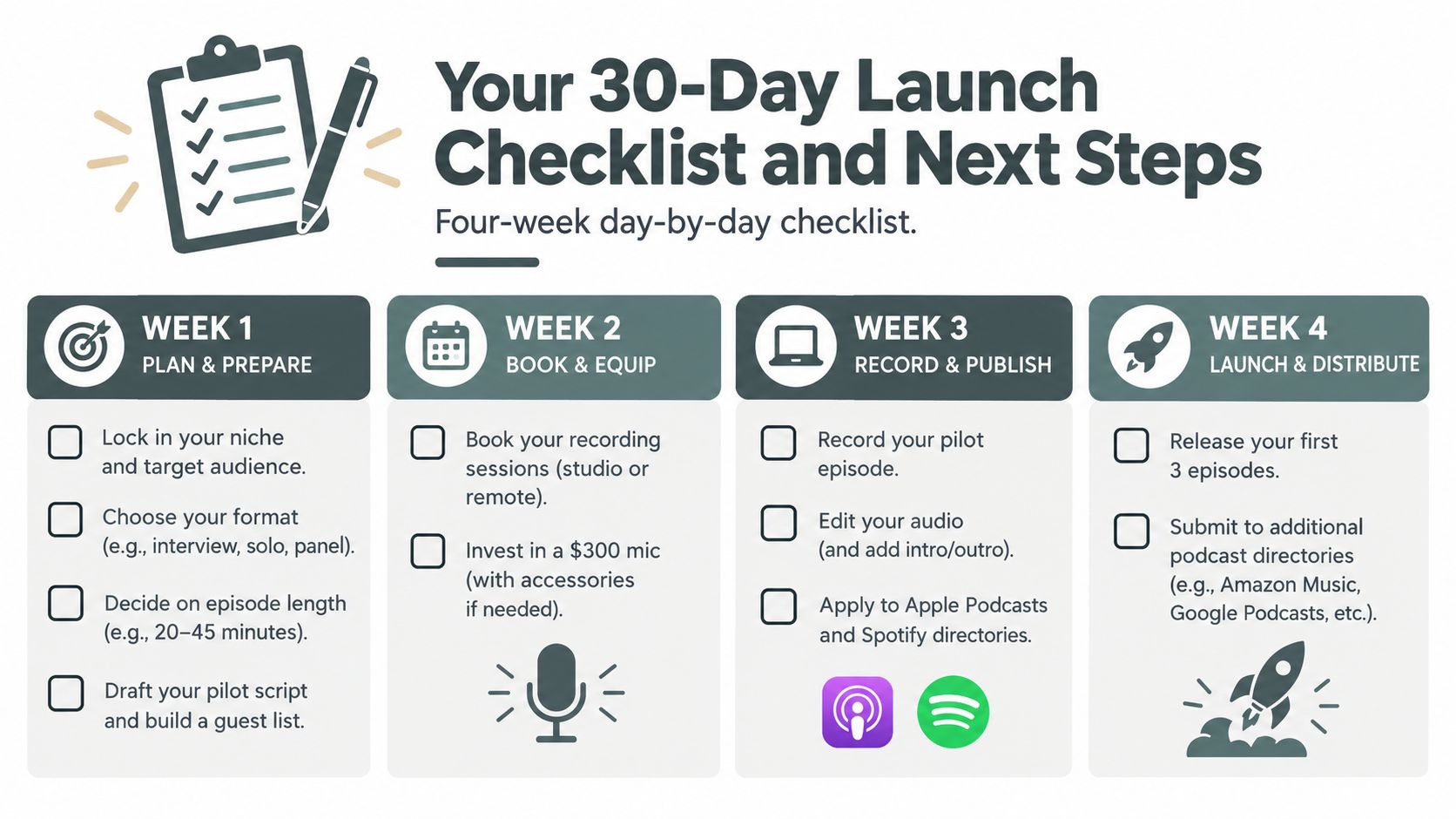
Week three, prepare distribution
Finalize realistic cover art, write show notes and episode descriptions, open the hosting account, generate the RSS feed, and submit to Apple Podcasts, Spotify, and YouTube Music at least seven days before launch. Validate every listing on a phone, not just inside the hosting dashboard.
Before publishing, review music licensing rules for every piece of music you use. If you collect email addresses, add a basic privacy policy. If the show may become a serious commercial asset, consider registering the name as a trademark after checking availability and speaking with qualified legal counsel.
Week four, launch with a buffer
Publish episodes four and five as scheduled content so your opening run has protection against interruptions. Run a soft launch with local coworking members and relevant niche communities, ask for specific feedback, and correct obvious problems before promoting broadly.
Set one call to action per episode. Invite listeners to subscribe, join an email list, book a consultation, attend an event, or explore a related offer, but don't ask for everything at once. For revenue, look beyond advertising. Paid memberships, workshops, and B2B consulting can fit a focused business audience more naturally than waiting for ad volume.
Read this guide to monetizing a podcast profitably when you have a clear listener promise and a repeatable publishing system. Then join a local podcast or creator meetup for accountability, feedback, and guest referrals.
Freeform House is envisioned as a premier, membership-based club in the heart of Jenks, Oklahoma's 10 District downtown, combining coworking, dining, collaboration, and community in a restored local setting. Its in-house podcast booth and creative spaces give members a realistic, authentic place to record and produce content without turning a home office into a permanent studio, while its broader gathering areas support workshops, meetings, and connections among local professionals.
Visit Freeform House to explore a membership-based coworking and community hub in downtown Jenks with an in-house podcast booth for consistent content production. Book a visit, review the available spaces, and choose a recording routine you can maintain through your first 20 to 30 episodes.
Comments